
Chapter 36 · A client launch film

Part 8 · Two productions, start to finish
A launch film for an Egyptian premium hair-repair mask: a jar, a cream, hands and hair, and one English line at the close. It was made for a real client and stopped after three rounds of stills, eight motion tests and a 33-page proposal. No frame or clip from it carries a recorded verdict. This chapter tells the production through the stages of the book, and says plainly what was made, what was judged, and what a job like this teaches when the judging did not happen.
In this chapter
The brief, the decisions made at the start, and what the client did not supply
Three rounds of stills in three worlds, each changed by a note from the client
The jar and its label: a product as the authority, and the four questions a label raises
The cream, as a material and as a transparent element
Eight motion tests, and what their prompts show
The English voice-over, the pulse and the formats
The proposal, read page by page
What was made, and what was judged
Before you start. Chapter 35 is the finished piece and the standard. This film is the other kind of job: a client commercial that never reached a cut. It follows the same stages, and it shows what changes when a client answers slowly, changes the look twice and never sees a frame in motion. Products and labels are taught in Chapter 10, moving shots in Chapter 14, rights in Chapter 34; this chapter points to them.
36.1 The brief and the decisions made at the start
Taught in Chapters 3, 4 and 8.
The client is an Egyptian company launching a premium hair-repair mask. The film was to be its launch advertisement, made entirely with AI, the author acting as the client's creative director and the client reviewing by messages and voice notes. The client's material was a storyboard PDF, voice notes in Egyptian colloquial Arabic with English terms, draft packaging and identity visuals, and a folder of reference videos.
The decisions the author made at the start are the kind the first-day card of 8.2 holds. On 6 Sep: the film's language is English only, for the voice-over and for every word on screen; the lead route rests on one idea, repair that goes to where the hair is damaged, carried by a short English brand line; a second route, built on an Egyptian woman's face, was kept as an alternative; the production route is fully AI-generated. On 12 Sep: hands and hair only, never a face; the film is led by sound design, with a pulse; it is designed for 9:16 first; the close is one short English brand line about where the repair goes; the spend ceiling for that round is about 250 credits, with the cost shown for each batch. On 22 Sep: a black-and-white world with natural skin, and a refresh of stills only, with no motion cut that round. Against the four decisions of 8.2, the delivery format (9:16 first) and the look were written down; the speaking-shot contract needed no decision, because no mouth is on screen (36.6); the rights class was never written (36.3).
The stills carry a small science story as images: a fibre with lifted scales, a moisture network that holds water inside it, a veil of lipids that softens without weight, a smooth surface that gives light back. These are the brand's own claims. They are proposals, not externally validated efficacy, and a film that shows them needs the client's authority for each one.
Two things were missing at the start and stayed missing. No budget or timeline was agreed, although the author asked for both more than once. And nobody sent photographs of the physical jar. A job with either gap should not reach its first paid frame, and this one did. The spending packet of 8.10 cannot be filled without a budget, and the reference manifest of 8.8 has no approved row for a jar nobody has photographed.
36.2 Three worlds in three rounds
Taught in Chapters 6 and 9, with the records in Chapter 8.
Three rounds of stills were made in three different worlds, and none of the changes was the author's whim. Each followed the client's answer to the round before.
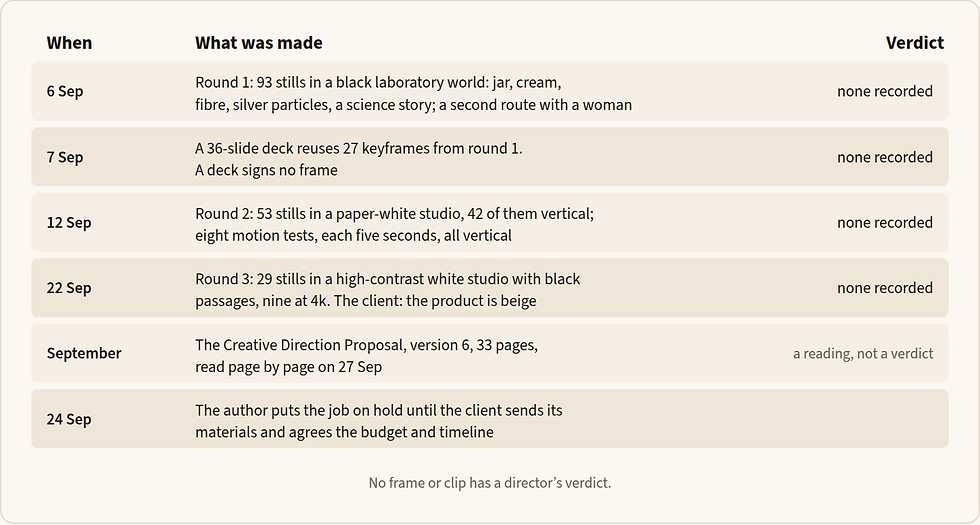
Figure 36.1 — The client film as it was made. The look changed at every round, and each change followed a note from the client. No frame or clip from the three rounds carries a recorded verdict.
Round 1, 6 Sep: a black laboratory. Ninety-three stills in one evening, 87 at 16:9 and six at 4:5. The prompts are of three kinds. The first fifteen open with a labelled block that gives the story intent, the emotional beat and the goal of the shot. The next thirty-one open with a concept, then the product's identity. The last forty-seven are reference plates for continuity (materials, a fictional woman, the empty laboratory lounge) and frames built from them; the reference-led frames give each attached picture one job and, in most, a "do not inherit" clause. The jar stands "in its own black laboratory world": on black glass inside a ring of ivory cream, suspended in black space with a silver rim light, split on a vertical line into the real jar and a cross-section opening into "an internal silver world of chrome particles, a fine glass lattice and ivory cream". The signature image was "thousands of tiny polished-silver particles frozen mid-stream": repair that goes to the damage. A woman appears in the plates too: an identity plate for a fictional adult woman, written down to a small flat mole high on the right cheek.
On 7 Sep a deck of 36 slides reused 27 keyframes from round 1. A director or a client can like a deck without signing a single frame in it, and no approval was tied to a job (the acceptance gate of 8.1; signing a frame, 9.12). The client answered on 8 Sep: the essence was captured, and the visuals were far from the client's own brand direction. They sent references for look, motion and pacing.
Round 2, 12 Sep: a paper-white studio. The day's decisions: a high-key, paper-white world; hands and hair only; a film designed for 9:16; four motion tests; the spend ceiling. Fifty-three stills, 42 of them vertical, in a "paper-white studio world with graphite black, brushed aluminium and warm-white cream only". The round began with seven reference frames for the things that must not drift: the cream's ridges and air pockets, the jar's geometry, the hair's colour and strand, the hands' skin and nails, the fibre's construction. Each later frame named the job of each reference and what it must not pass on (10.5).
Two small edits from that day repay study. One asked for "only one tiny typography correction": the label's volume line, 300 ml / 10.1 OZ, had lost its decimal point, and the edit asked the model to restore it and keep every other letter. It is the one-change edit of 10.13, and the frame it produced became the start frame of the jar-slide clip; whether the correction held is not recorded. The other removed "the entire steel blade so there is NO sharp cutting instrument" from a frame of hair and put a blunt, wide-tooth comb in its place. A blade in hair reads as cutting; a comb reads as care. That is production design, not prompting (Chapter 7). The author's notes count the session's spend at 123 credits, and some of that day's spend was not this session's.
Round 3, 22 Sep: a white studio with black passages. The client's notes asked for a white, very light grey or black background, a distinct high-contrast black-and-white look and clearer transitions, and said the proposal's visuals felt overly AI-generated. The author's answer was a black-and-white world with natural skin, a white studio with black passages, and a stills-only refresh. Twenty-nine stills: the jar on a white plinth with one hard shadow; the fibre as white scales on black; the cream near-white on very light grey; the hair in three states (dry, coated, held) against white. Nine ran at 4k and the rest at 2k. The notes count six anchors and 21 keyframes and 76 credits.
What the round 3 prompts carry. They run from 342 to 622 words, median 473. Each attaches references with one job apiece and a "do not inherit" clause. Twenty-three open the picture with a medium declaration ("A digital-cinema frame from a high-contrast white-studio hair-care launch film"), and the other six are reference plates. Each has a frame inventory (foreground, midground, background), a lens, a stop, a colour temperature and a 4:1 light ratio. All 29 carry the same finish sentence, pasted word for word, and all 29 end on the closing line that bans only overlaid text, subtitles, logos and interface graphics. Fourteen declare the frame static. That is the finished grade of 9.1 in form, applied to a real client's product, and the missing verdicts matter more for it: nobody has yet looked hard at what all that structure returned. The stills were written for Nano Banana Pro (Chapter 11). The platform's job record (33.1) holds the engine's id but not the id that was asked for, so it cannot say whether every jar came from that model; the run record (8.7) keeps asked, recorded and billed apart for this reason.
36.3 The jar and its label
Taught in 10.11 and 10.12, with rights in 34.6.
A product film lives or dies on the product. The rule of 10.11 is that the real thing is the authority: its photographs outrank any words, a brand mark is generated from the real asset attached as a reference, and compositing from the real artwork is the fallback where the mark must be exact. This job is where that rule met a jar.
What the jar was made from. The author locked jar fidelity as reference-guided from the client's packaging material, which was draft packaging and identity visuals. On 22 Sep the cover note to the client asked for six phone photographs of the physical jar on white, to anchor the frames and fix the label. None arrived.
The jar in words and in pictures. The round 3 prompts attached two pictures, each with one job, and then described the jar anyway:
"Image 1: the jar exactly — its geometry, proportions, matte black lid, translucent ivory body and the complete printed label; do not inherit its warm paper ground, its cream smear and its exact placement in that frame."
"Image 2: the label's copy, letterforms and brushed-silver material; do not inherit its close framing, tilt and shallow focus."
then "Use the product exactly as shown; preserve shape, design and proportions; do not redesign."
That is the fidelity clause of 10.11, carried in every shot that shows the product. Whether it holds a printed label is what these frames would show if anyone judged them against a real jar, and nobody has.
The label raises four questions, and this job met all of them.
Can the model copy it? The round 3 prompts spelled out every printed line of the label in order and asked the model to "preserve every character, joining, dot, numeral, line order, and direction; add no other words or symbols". Earlier rounds had already shown the risk in three forms: on 7 Sep the label needed a text composite owned by post; on 12 Sep the serif of the monogram on generated labels was still open, to be fixed from artwork in post; and the decimal point in the volume line was lost and restored. The order holds: generate the mark from the real asset as a reference, read it glyph by glyph against the artwork at full size, and where the copy must be exact, composite it from the artwork.
Where does the type go? The prompts left room for it in words: "the upper third empty for the wordmark and product name". The type layer is then set in post and never generated (10.12, 30.9).
Does it survive motion? The fall test asked for the label to stay "sharp, legible and unchanged throughout" through a rotation. If a label smears in a move, composite it from the artwork over the landed hold (10.11, 14.10).
May it be uploaded at all? The platform's terms let it use what you upload to train its models; only customers under an enterprise agreement are excluded, and deleting content stops future use only (terms last updated 26 Jul 2026, checked 30 Sep 2026; 33.9 and 34.5). The rule of this book is that an unreleased pack stays off the platform (34.6): use a plain stand-in jar of the same shape, never write the product's name in the prompt, and composite the real pack in post until it is public and the client has agreed in writing to its upload. The frames of all three rounds used an uploaded reference of the client's pack, and nothing shows that the pack was public or that the client had agreed. The rights gate was skipped; on the next job it comes before the first upload.

Figure 36.2 — The pack goes to the platform only with permission; a mark that must be exact is composited from the real artwork.
36.4 The cream
Taught in Chapters 7 and 12.
The cream is the film's second product. On paper it changed colour from round to round: "warm ivory" on 12 Sep, near-white on 22 Sep. The client's note of 22 Sep, in answer to the sixth version of the proposal, was that the product is beige. The note can be read two ways: as a complaint that the product looks beige, or as a description of the product the client wants kept. The note came after the round 3 frames, whose prompts had already gone with near-white and asked for "no warm or ivory tint". No question about it is on file. When a client's one-line note can change the colour of the hero, ask what it means before you re-shoot.
As a material. Each round wrote the cream as a physical thing, not a colour: "ridges, peaks, air pockets, satin-matte", a density, a raking light across it, and a spatula leaving "one clean shallow channel with compressed edges and minute ridges showing viscous resistance". The cream is where the film shows touch without a face, so its surface does the work a performance would do elsewhere. Chapter 7 teaches materials as production design (7.2).
As a transparent element. For a black passage or a type card, the cream can be made as its own element: a single swipe with one spatula channel on a transparent background, from GPT Image 2.5, which offers a transparent-background output (12.1). It is an invented element with no identity to protect, which is why the route is safe. It was proposed for the black passages and never made. Check the result over black and over white before it goes anywhere near a cut.
In motion. Two of the motion tests moved cream: a ridge settling inside a jar split between label and texture, and a hand spreading cream along damp hair. Neither carries a verdict.
36.5 Eight motion tests
Taught in Chapters 13, 14 and 16.
On 12 Sep eight short clips tested how the product would move. The plan for the day was four; eight ran, because two AI assistants were working the job at once and each ran its own set. A spend ceiling only works if one person holds it (8.10). All eight are vertical and each is five seconds. None has a quality record or a director's verdict.
Four on Kling 3.0 Turbo, at "1080p", run by the second assistant: the jar sliding a short way and holding; a cream ridge settling in the split jar; a hand spreading cream along hair; a comb drawn a short way through a tress. The prompts run 98 to 108 words, each with six to eight exclusions, and each asks for silence in words. The mode offered no sound setting, and all four came back with a stereo audio track, at 1076 × 1928 rather than 1080 × 1920. Probe every file on arrival (30.2).
Three on Kling 3.0 pro, sound off: the jar falling, turning upright so the label faces the lens, landing with one small bounce and holding; and five ingredient objects sliding in to ring the jar, once with an end frame and once without.
One on an earlier version of Seedance than the one Chapter 17 teaches, so it is left out of what follows.
Even with no verdict, the prompts show two habits worth copying. "Exact front-facing orientation" states the wanted state positively and holds it to the end, which is how 14.10 asks for a product to stay put. And "The comb gently moves 1 centimetre down along the hair direction over two seconds" already has the shape Kling wants, one magnitude and a duration. The six to eight exclusions are past the ceiling of five and well above the three or fewer the book advises on a clip (2.7); an exclusion earns its place by naming a drift you expect, and eight is a sign that some of them were nerves.
The cheapest next step on this job is not another generation. It is to watch the seven Kling clips, look at the last frame of the fall at full size, and decide whether the label survived. That would be the first verdict on Kling at 9:16 and on a printed label in motion.
36.6 The English voice-over, the pulse and the formats
Taught in Chapters 21, 23, 25, 26 and 30.
The close. The film's close is a short English brand line about where the repair goes, decided on 12 Sep with the pack's name. It is one line in a voice chosen for the brand's register: one bracket of direction, the words, and an ellipsis for the pause before the claim. The voice, not the spelling, carries the accent (23.2). For an animatic, a scratch read from the platform's text-to-speech is fit only for timing (21.3). The second line, the brand line of the lead route, belongs to the route. Because the film shows no face, the speaking-shot contract of 8.2 is settled by design: no mouth is on screen, so nothing needs a plate or a sync pass. Neither line was cast or recorded.
The pulse. The film is sound-led. Its music was briefed as a pulse that tightens layer by layer, holds back under the voice-over, and lands on one accent, with a percussion part cut on a grid so that the picture can be timed to it, and the space under the closing line cleared (Chapters 25 and 26). None of the cues was generated.
The formats. The film was designed 9:16 first. A 4:5 cut-down was written two ways: recomposed as a new frame, and extended at the edges. The book's rule is to originate each aspect rather than crop it (30.8).
36.7 The proposal, read page by page
Taught in Chapter 4.
The film's creative direction reached the client as a proposal. Version 6, 33 pages, attributed on its cover to the author, was read page by page on 27 Sep with every page rendered and inspected. A proposal is static: it shows what the film could be, and nothing in it was tested in motion.
What is worth copying.
A set of images, each with a different job. The cover's oversized jar on a plinth; a hand holding a narrow section of hair; three hair states; a close, sculptural fibre surface. Product portrait, human contact, material macro, mechanism, states: one lighting logic, different functions.
State changes, not mood pictures. The product airborne, settled, and raised on its closing plinth; scoop, comb and finished hair; damaged, attracting and sealed fibre.
Motion made inspectable. Six transitions named, then shown as strips of ten illustrated states each, so a reader can see a panel enter, cream replace the previous image, a jar descend and settle.
Craft beside its image. Narrow labels beside one to three vertical images: the action, the words on screen, the move, the sound, all about the same event.
A close that answers the opening. The plinth image of the cover returns on the last page.
What was flagged. A 60-second diagram whose listed segments add up to 57 seconds, and a closing interval of seven seconds described later as a four-second hold followed by the black card: reconcile the numbers before the layout. A page that names Kling, and working codes for transitions across the treatment pages: operational language that a client edition leaves out (4.9). And the science and repair claims, which are the brand's to prove, not the film's.
36.8 What was made, and what was judged
Taught in Chapters 8 and 29.
What | How much | Verdict |
Stills, round 1 (6 Sep) | 93 | none recorded; 27 keyframes reused in a deck, which signs nothing |
Stills, round 2 (12 Sep) | 53 | none recorded |
Stills, round 3 (22 Sep) | 29 | none recorded |
Motion tests (12 Sep) | 8 | none recorded; no quality record |
The proposal, version 6 | 33 pages | read on 27 Sep; the client's answer, beyond the note on the cream, is not in hand |
The total cost was not recorded. The stills were billed at the usual still price, and the author's notes give 123 credits for round 2's session and 76 for round 3's stills. The Turbo tests were quoted at 10 credits each (16.9); the actual charges for the motion tests are not on file. On 24 Sep the author put the job on hold until the client sent its materials and agreed the budget and timeline. The client's reply was a link to a folder that, in the author's reading, held none of what had been asked for.
The failure is not in the making. The stills follow the finished grade, and the tests are sensible. It is in what surrounded them: a look that changed twice on a client's note, a pack that went to a platform without the client's word, a product colour nobody clarified, and 175 stills and eight clips with no verdict on file. Chapter 8 exists to stop exactly this: a lock before a look is chosen, a spend gate before a batch, a rights gate before an upload, and an acceptance gate that a person passes frame by frame.
What this job teaches. Making is not judging. A production can generate 175 stills, eight clips and a 33-page proposal and still hold no evidence of what works, because no verdict is recorded against any frame. The cheapest next step is not a generation: it is a director's verdict on what already exists.
Open questions
Whether a printed Latin label can be copied from a photograph of the pack. Judge the round 3 jar frames against the real pack, glyph by glyph, once the six photographs exist.
Whether the pack was cleared for upload. Until it is public and the client has agreed in writing, use a stand-in.
The cream's colour. Beige, as the client said on 22 Sep, or near-white, as the round 3 prompts said. Ask.
The science claims. They are the brand's to support before any film states them.
What to remember
A product film's authority is the product: attach the real jar and the real label, one job each, and forbid redesign (10.11). Ask the client for photographs of the real pack before the first frame, not after the third round.
Generate a brand mark from the real artwork as a reference and read it glyph by glyph; where it must be exact, composite it from the artwork, and set the words on screen in post (10.11, 10.12, 30.9).
Before a client's unreleased pack goes to a platform that trains on uploads, check that it is public and that the client has agreed in writing; otherwise use a stand-in (34.6).
Write a product's move as a positive state held to the end, and a small move as one magnitude and a duration (14.10).
Look for what an image says beyond its subject: a blade in hair says cutting (Chapter 7).
Approving a deck does not sign its frames. Sign frames one by one (8.1, 9.12).
Reconcile a proposal's numbers, and keep tool names and working codes out of client documents (Chapter 4).
When a client's note can change the hero's colour, ask what it means.
When a production has made a great deal and judged nothing, judge before you make more.


Comments