
Chapter 3 · The concept

Part 1 · Before the camera
A generator makes the film, and what makes the film worth its credits is decided earlier, on paper: what it is about, what it refuses to do, and the one device that turns a truth about people into something an audience will repeat. This chapter teaches how to get from a brief to an idea worth making, how to test it before anyone falls in love with a picture, and what changes when any picture you can describe can be rendered by the afternoon.
In this chapter
What a concept is, and who decides it at this stage
What remembered work has in common
Reading a brief, and rewriting it before you answer it
From observation to tension; the enemy, the brand's role, and the refusal list written before any idea
Two ways to generate ideas, tools for when you are stuck, and when to stop
Testing an idea: necessity, retelling, the scene engine, endings, and judging without killing boldness
What changes when anything can be generated
The concept page, and the gate to the treatment
Before you start. Chapter 1, for what the director's job now is. Chapter 2, if you develop ideas with an assistant. Chapter 4 takes the concept into a treatment.
3.1 What this stage decides, and who decides it
A concept is the idea a film is built on, stated so that it could be made in more than one way and still be the same idea. "On the last night of the month a man carries his leftover gigabytes from door to door on a covered tray, the way an Egyptian host presses a third plate on a guest" is a concept. "A warm Cairo stairwell at night, long lenses, an oud swell on the reveal" is an execution: it describes how one version might look, and it would fit a hundred other films. (Both are written for this book.)
The difference matters more with AI. An execution can now be rendered in an afternoon and look expensive; a concept cannot be rendered at all, only chosen. As execution becomes easier to simulate, boldness moves up into the architecture of the concept, and the scarce question is no longer "can we make this image?" but "does this idea have taste, tension, consequence and a form nobody can ignore?"
Who decides. On a commercial the concept usually arrives from an agency, and the director's first job is to protect and sharpen it (Chapter 4 begins there). When the brief comes to the director directly, the concept is the director's to make. Either way this stage ends in one decision: which idea goes forward, with a recommendation and the strongest alternative, on a one-page concept page (3.9). It costs no credits, and it is signed before a treatment is written, because everything after inherits it.
Several words in this chapter carry a working meaning. Here they are, once.
Word | In this book |
Tension | two things pulling against each other, written as one two-sided sentence |
Device | the formal or structural move that carries the idea: a split screen, a repetition, a rule the film keeps |
Mechanism | what the audience does while watching: laughs at a repetition, waits for a reveal, does the arithmetic before the film does |
Refusal | something the category always does that this idea will not |
Enemy | the feeling, habit or norm the brand stands against; almost never a competitor |
Brand role | what the brand does in the film; intrinsic when the idea cannot exist without it |
3.2 What remembered work has in common
Agencies known for distinctive work describe cultures built to distrust the first wave of ideas, because the first wave is the most category-native. Wieden+Kennedy argues in its "Case for Chaos" that without dissent groups drift toward conformity. BBH asks every brief for a "zag". FCB separates an idea that looks big from "a big idea in culture". Sir John Hegarty's line is the bluntest: "No great idea has ever come out of a brainstorm meeting." The working rule that follows: generate broadly, present narrowly, and keep dissent alive longer than feels comfortable.
Why does some work become retellable shorthand? A few Film and Film Craft winners and much-cited case studies, read for what each was about, what form it took and what it refused:
The work | The truth | The device | What it refused |
"It's a Tide Ad" | audiences know advertising's clichés better than advertisers admit | every Super Bowl ad genre is hijacked, and each turns out to be a Tide ad | category seriousness |
"#WombStories" (Bodyform/Libresse) | women's experience of the womb is complex, and advertising flattened it into euphemism | live action woven with animation, each womb its own world | the sanitised codes of the category |
"Save Our Species" (Lacoste) | a famous brand's most valuable asset may be its own icon | the crocodile replaced by endangered species, in the numbers left in the wild | the sanctity of the logo |
"Nothing Beats a Londoner" (Nike) | young identity is performed through local obstacles, slang and one-upmanship | a rapid brag contest across neighbourhoods | generic "inspirational youth" |
"The Talk" (P&G) | racism arrives as a survival script parents repeat | a montage of Black parents across generations preparing their children for bias | a resolution, a happy ending |
What the winners share is not better art direction or a bigger budget. It is five properties stacked in one idea.

Figure 3.1 — The five-property stack. A reading of the pattern in the winners, not a law.
Three consequences run through the rest of the chapter.
Insight is the entry ticket; craft is a multiplier. Without a meaningful truth the work rarely travels beyond competence. Cannes' own definition of Film Craft asks for technical skill "elevating an idea or dramatically enhancing its execution" (checked 30 Sep 2026): craft amplifies an idea already worth amplifying, and a beautifully made conservative idea stays conservative. With AI this is the trap to watch, because craft of a kind is now cheap.
Bravery usually means the brand gives something up. Lacoste gave up its crocodile, Tide gave up category seriousness, Bodyform gave up the sanitised and flattering. That is why "the version your client won't approve" is not juvenile extremism: it is often the only route to the live wire in the brief.
Specificity works when it is structural. "Nothing Beats a Londoner" becomes more universal by being more local: the density of slang, neighbourhoods and street friction gives it its energy while the competitive performance of identity stays human. Replace vague "universal emotion" with precise rituals, surfaces, speech, institutions and frictions, and let the universal feeling arrive through local detail. The public record on how ideas are made is far richer for British, American, French and Australian work than for Cairo, Riyadh or Dubai, so test every local truth against a native reader.
3.3 Reading the brief, then rewriting it
Define success as something a viewer experiences. Before any idea, write down what should become interesting, what should be understood about the brand and what change should be felt. Translate "high-budget" into evidence you could point at: deliberate art direction, a camera placed for a reason, performances that listen, the product exactly itself, an edited rhythm, finished sound, consistency from shot to shot. A brief that asks for "premium" is asking for these.
Separate the facts from the claims. A brief mixes what is true about the product with what the client would like to be true. Mark each claim you cannot verify. A claim you cannot verify may become the film's question, never its endline.
Read the mandatories as constraints, not as the idea. A name spoken once, a mechanic that must be understood, a language, a length: each narrows the field, and some of them turn out to be the idea.
One invented brief runs through this chapter and the next.
The running brief (invented for this book). Sada, a prepaid mobile network in Egypt. Product truth: data not used by the 30th rolls into the next month instead of expiring. Objective: switch 20-to-35-year-olds from the other networks. Category clichés: rockets, lightning and cheetahs for speed; signal bars; glowing lines across the Pyramids; a family video-calling on a sofa; the footballer cameo; UNLIMITED in capitals. Mandatory: the name spoken once; the rollover understood without a caption; Egyptian Arabic; a 45-second hero and a 15-second cut-down; comic tone. Unverified: the client's line "nobody wastes a gigabyte on Sada", an assertion that no idea may state as fact.
Rip the brief before you answer it. Challenge its frame before you solve it, or the room will produce polished answers to an unchallenged question. Write three re-briefs:
The anti-brief: if the category's normal logic were false, what would the brief become? (For Sada: a network that does not sell speed at all.)
The act-brief: if the brand had to do something rather than say something, what would it be? (Remove a deadline.)
The enemy-brief: if the real enemy were a habit or a date rather than a competitor, what would the brief become? (The 30th, and the habit of burning what you paid for.)
Then write three "How might we" questions: one broad, one culturally specific, one emotionally dangerous. The good ones open the problem rather than fill it in: "How might we communicate this benefit?" narrows at once; "How might we make an expiry date feel like a wasted meal?" leaves room for many answers. Ask them before generating anything.
3.4 From observation to tension
The most common failure in concept work, human or machine, is to build on an observation as if it were an insight. "Gen Z uses TikTok" is true and inert; pushed until it has a tension in it, it becomes "Gen Z uses TikTok to escape the pressure of being perceived as productive". "Busy moms need convenience" becomes "busy moms crave three guilt-free minutes of 'me time' disguised as productivity". The second sentence in each pair is a playground; the first is a statement.
Keep asking "So what?" until you reach a paradox. Fertile tensions belong to three families:
Want against avoid: the person wants the outcome and hates the process.
Now against later: the pull between what pleases today and what it costs tomorrow.
Self against others: the gap between who someone is and who they perform being.
The truth ledger. Before any idea, write six to ten behaviours around the brief and label each one: observation (documented or widely observable) or assumption (plausible, unverified), with the question a native speaker or a field visit would answer. It catches the idea that is out of date before anyone builds on it. Three lines from Sada's ledger show the form (drafted here; a native reader must confirm them):
Nothing edible is thrown away: bread is kissed and moved aside, leftovers are packed for the neighbours (observation).
A host presses a third plate on a guest, the guest refuses twice, and both know the refusal is part of the ceremony; a plate is never returned empty (observation).
On the last night of the month people burn what is left of their data on things they do not want (assumption to check: ask three people of the target age what they actually do).
Turn each truth into one two-sided sentence, and stop there: no idea yet.
You would never throw away food, and every month you throw away gigabytes you paid for.
You pay for data you are afraid to use, and on the last night you burn it on things you do not want.
Generosity is a way of not wasting, and the 30th makes you generous with something nobody asked for.
Enemy, truth and role. Much award work stands on four pillars: a cultural truth, a product truth, a brand enemy and a brand role. The enemy is rarely a product on the next shelf; it is a feeling, a norm or a state of being, and an idea is only as strong as its enemy: the more intangible, cultural and pressing it feels before the brand intervenes, the more the film has to push against. For Sada: the cultural truth is that nothing edible is wasted; the product truth is that unused data rolls over; the enemy is the 30th, the date that turns what is left into waste; the role is to take the date away.
Snickers' "You're Not You When You're Hungry", by BBDO, shows tension used well: the truth is that hunger turns you into an irritable stranger, the device casts famous faces as the symptoms, and the product gives you back to yourself. It says nothing about peanuts or taste, and the device repeats in any market, which is part of why the campaign is a benchmark.
3.5 The refusal list comes before any idea
Award work is defined less by what it says than by what it refuses. "The Talk" refused resolution. "#WombStories" refused euphemism. Safe work keeps all the old scaffolding: an inspirational voice-over, a redemption arc, beauty language, a problem, a solution and a product, the category's colours, flattery of the audience, and a last line that explains the film you have just seen.
Write the refusal list first, before any idea exists. It gives every later idea something to be tested against. Sada's, in one paragraph: no rockets, lightning or cheetahs; no signal bars or glowing network lines; no family on a sofa, no footballer, no UNLIMITED; no smiling face lit by a screen; no counter or countdown as the hero; no voice-over that explains the rollover, which must be understood from action; no triumphant finale unless it costs something.
Replace structures, not just surfaces. A cliché pass that swaps the wise grandmother for a finance influencer, or falling coins for rolling digits, changes the surface and keeps the structure. Check the structures: the ending that explains, the voice-over that narrates, the montage with a counter, the emotional reversal the category always uses. If the film runs problem, solution, product, rebuild it as tension, device, release.
Know the category's codes, and why breaking them pays. Ipsos reports that 61 % of Effie winners break category conventions (published April 2024), and finds the 2024 global Best of the Best contenders 39 % less likely to follow them (both checked 30 Sep 2026). Read these as a description of what many winners share, not proof that breaking a convention wins. The Von Restorff effect explains why it helps: the one item that differs from its surroundings is remembered longer. The standing example is Whyte & Mackay's The Woodsman whisky: a category of rolling Scottish hills, slow amber pours and oak barrels, all dropped for Barry the Beaver, an animatronic puppet who unwinds in a bar with a whisky after a long day building dams.
List the five most expected answers, and ban them. Detective fiction has the rule that the culprit is never the obvious suspect; the first and most logical answer to a brief is set aside precisely because it came first. For Sada the five are speed, signal, the sofa call, the footballer and the countdown. With them gone the room reaches the second and third associations.
Know your own market's defaults. Public summaries of successful Egyptian Ramadan campaigns keep returning to unity, music, family, football icons and emotional connection. None is bad material; each is a default code unless the idea can say why this behaviour and this gesture make the moment newly true.
When the brand's own asset is the cliché, decide before you generate. If the name is the piggy bank, or the product is the sofa, the object is unavoidable; whether an idea reclaims it or relapses into it is a judgement for the director, made openly before ideas are written.
3.6 Generating ideas
Two generators
Run two generators side by side, not one after the other.
The first asks: which dramatic mechanism embodies this tension? A person who does something the audience watches. Its weakness is that the people repeat: the same wise witness, the same two-line exchange at the end. Chapter 15 teaches the Egyptian comic beat as performance; here, watch for it turning into a template.
The second asks: which device would be the product's own mechanic? List devices that make meaning by their form alone, and for each ask three things: what meaning does it create by itself; does that meaning coincide with part of the product's mechanic; would it work equally well for any product. If it would, it is decoration, and it goes. A Sada audit, in part:
Device | What it means on its own | Decision, and why |
A countdown | urgency | discarded: it shouts "hurry" about a product whose truth is "no hurry", and it is the category's structure |
Split screen, with and without | simultaneous comparison | discarded: comparison is the category's habit, and the well-known split-screen film is the reference everyone will name |
A rule the film keeps: one night, one building, one tray | the deadline made physical | kept: the rule is the 30th itself |
A ritual with a known script: the host who will not take no | recognition; a joke the audience finishes | kept: every Egyptian knows how it ends, so the film can spend its time on the variations |
The discard step, with a reason for every device killed, is the best feature of this generator. Its weakness is the reverse of the first: the people arrive last and thin.
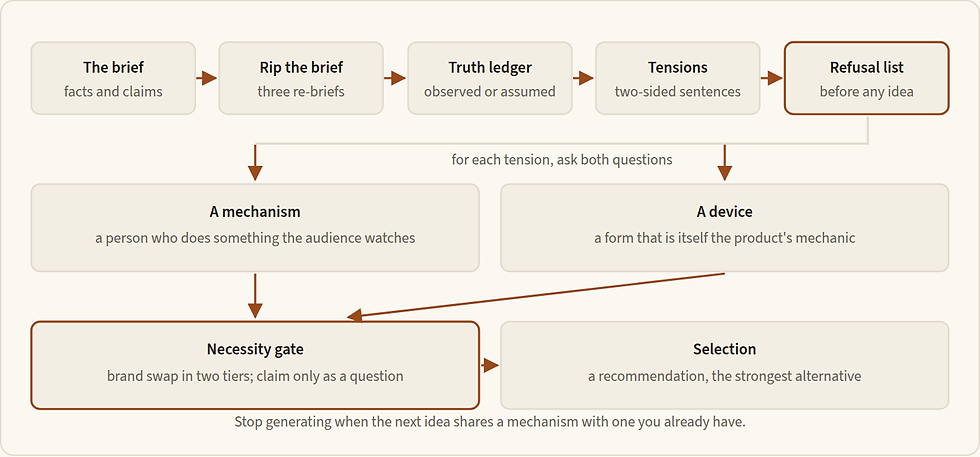
Figure 3.2 — The order of work: truth and refusal before form, form before selection, no quota anywhere.
Tools for when you are stuck
The classic provocation techniques are tools for a stuck room, not compulsory passes. Run as a fixed sequence, each tends to produce its own genre default.
Tool | What you do | What it is good for |
Po (Edward de Bono) | state something absurd on purpose ("Po: the product is never shown") and move from it rather than judge it | breaking premature reasonableness |
The opposite | "Whatever you think, think the opposite" (Paul Arden): write the sensible film, then invert its emotion, look and setting | escaping the brief's implied answer |
Reverse brainstorming | ask how to make the film more boring, more corporate, more ignorable, then ban what appears | making the cliché path explicit |
The taboo | name what the category avoids saying, showing or admitting | heat; it must be relevant, not exploitative |
An arbitrary constraint | one hard rule: one location, no dialogue, one continuous action, no product, six spoken words, one ritual window | pressure; the obvious solutions no longer fit |
A recipe that combines several: write the sensible film; invert its emotion, look and setting (sunny, earnest and domestic becomes nocturnal, cynical and surreal); introduce one specific unrelated element, a character, an object or a rule; then let the product solve the problem this creates while staying entirely serious, the straight man to everything around it. The Woodsman's puppet is close to this recipe's unrelated element.
Know what bold looks like when it arrives. The brand destroys or alters its most famous asset. The category's biggest weakness becomes the core symbol. The film keeps one rule so rigid it becomes memorable. Local texture is so dense that it gains universal energy. The product is largely absent because the tension is more ownable than a demonstration. And the idea, said in one sentence, still sounds unlike a normal advertisement.
When to stop
Stop when the next idea shares a mechanism with one you already have. Three to five ideas will emerge. Quotas (three culturally specific, three device-first, three in which the brand acts, three that start from discomfort) can check that you have looked in several directions; they are not a target.
Record every discarded idea with a one-line reason, so that it cannot quietly come back.
When two routes land on the same material, keep the material and demand a more specific mechanism.
3.7 Testing an idea
Judge the idea and its execution separately. A beautiful film with a predictable mechanism can fail the first test; an original premise with lifeless performance can fail the second. A complete file, a long rationale or a pile of references stands in for neither. This chapter tests the idea; Chapter 29 judges the film.
Is the brand necessary?
The oldest test is the logo swap: if a competitor ran the idea tomorrow, would it feel wrong? If a competitor's logo could go on the end without breaking the film, the idea is a commodity. Run it in two tiers.

Figure 3.3 — The brand-swap test in two tiers. Sada's idea breaks under Tier A (a network with no rollover cannot run it) and survives Tier B (a rival with the same rollover could): the mechanic owns it, so the brand still needs something of its own to hold.
Read the result with care. A brand with no character beyond its name will often survive Tier B, and an idea that survives it is one the brand does not yet own. For Sada that is a job for the endline and the ritual phrase (3.9), not a reason to drop the idea.
Three more checks belong at the same gate.
An unverified claim may be the film's question, never its endline.
The mechanic must be understood with the sound off, or with the picture off. Some ideas pass only one; know which, because it decides where the film can run.
The name should be spoken where the idea turns, not tacked on at the logo.
The questions an idea must survive
Agencies' own tests, gathered into one gauntlet: BBH's zag, FCB's "a big idea in culture", Mother's "Make Our Children Proud".
Test | The question |
Zag | is this meaningfully different from what the category would do? |
Device | does it have a formal move that people can retell? |
Refusal | what does it refuse that the category relies on? |
Ownability | if a competitor ran it tomorrow, would it feel wrong? |
Act, not ad | is the brand doing, changing, revealing or risking something real? |
Specificity | what local ritual, institution or friction gives it oxygen? |
Residue | what feeling lingers after the film ends? |
Craft multiplier | would better craft intensify it, or is craft hiding a weakness? |
Audience first | would the audience care if the logo stayed hidden for most of the film? |
The AI test | if a model could make 200 gorgeous frames of this cheaply, would the idea still stand out? |
Kill anything weak on zag, device or refusal at once, however well it fits the strategy. Add one more test that costs nothing: say the idea in one sentence, as if on the phone. Ideas that need a paragraph to explain usually need a voice-over to work.
The scene engine
At the level of a single scene, check an idea as a dramatist checks a scene: the character's goal, the obstacle, the tactic they use, the reversal, and the value shift from the start of the scene to its end. If nothing shifts, the scene is inert, however well it is made. Sada's first door: Samir's goal is to be rid of six gigabytes; the obstacle is a neighbour's polite ceremony of refusal; his tactic is insistence in the host's own words; the reversal is that Um Hany turns his gift into hers, and the plate that comes back is full; the value shift runs from "I am about to waste something" to "I have been given something for what I could not give". The brand arrives as a rule of the world, not as a product shot.
Develop, then attack
Build three versions of each surviving idea: safe, bold and reckless. The reckless version is where the hidden energy is stored; the bold version inherits it while staying credible for the brand. Do not show only the safe one, even internally.
Then argue against your favourite. Have someone argue that each advancing idea is actually generic, exploitative, unownable or over-crafted. If it cannot survive that, demote it.
Run the anti-cliché passes on what survives.
Delete the first answer: name the most obvious execution and remove it.
Purge the category's tropes.
Remove the explanatory ending: if the idea needs a last voice-over line to make sense, strengthen the structure.
Remove the emotional crutch: test the idea without a sentimental score or an inspirational voice-over.
Swap the frame from problem, solution, product to tension, device, release.
Stop the voice-over saying what the picture shows; let words and picture say different things.
Replace every generic universal with a precise cultural detail.
Make the brand wait: can it reveal itself later than you planned?
Simplify for the room: a client should grasp it at once, without jargon.
Ask whether it could become a case study; "a nice campaign" is not ready.
Endings, and the tone made physical
Write more than one ending before you lock. Three endings to the same set-up: one dramatic, one absurd, one subversive or left open; on paper the cost is a paragraph. Sada's three: at midnight his number vanishes and he sits on the stairs with an empty tray; in the last minute every neighbour asks for the gigabytes and he can only shout that they are gone; in the morning a covered plate waits at his door from every neighbour, because a plate never returns empty even when nobody took what was on it. The ending you choose sets the tone of the whole film.
Compile the tone into something physical. "Deadpan" is a word; a tone anchor is an instant you could film. Sada's: the half-second after the accountant's line, when Samir's smile stays exactly where it was and the cloth slides off the phone.
Judging without killing boldness
Two agency scales give a room a shared language for ambition. Leo Burnett's 7+ scale, as the agency words it, runs 1 "Destructive", 2 "No idea", 3 "Invisible", 4 "I don't know what this brand stands for", 5 "I understand the brand's purpose", 6 "An intelligent idea", 7+ "An inspiring idea, beautifully crafted", 8 "Changes the way people think and feel", 9 "Changes the way people live", 10 "Changes the world" (checked 30 Sep 2026), and asks for 7 or above. Heineken's Creative Ladder has ten steps from "destructive" to "legendary" and treats "cliché" as a barrier below which no work may fall (checked 30 Sep 2026). "Is this a 4?" is a quicker conversation than a paragraph of doubt.
Do not let a score choose. A scorecard rewards what is easy to score, fit and safety, and boldness is what a fixed axis penalises; the agencies use their scales as language, not as a machine that picks. Compare ideas with reasons, name a recommendation and the strongest alternative, and let the director choose.
3.8 What changes when anything can be generated
The machines pull toward the average, so the brief to them must pull away. A language model predicts the likeliest next words; left alone it returns the safe, category-typical idea, and image and video models do the same with pictures (Chapter 1). When you develop ideas with an assistant, work against the pull on purpose: ask first for the five most expected answers and ban them; ask for the opposite of the sensible film; ask for three endings; ask for many widely different ideas before choosing one; vary its residue before a client sees anything.
Pictures arrive before the idea is chosen, and they seduce. Easy visualisation keeps weak ideas alive: a glossy showroom of impossible objects is the AI-era default, and craft-based scoring then rewards it. Choose the concept on tension, device and necessity first; render afterwards. The AI test in the gauntlet is the check: if two hundred gorgeous frames cost nothing, would the idea still stand out?
Use the machine to widen and to prototype, not to decide. AI speeds ideas, mood boards, roughs, scripts and prototypes; it does not replace local insight, taste, emotional judgement or the core idea. To widen the field, brief an assistant to pull away from the average (Chapter 2). Once an idea is chosen, two or three test-grade stills of its key beat are the cheapest test of whether the device reads at all (Chapters 9, 11 and 12), and a scratch voice cut to stills tests the rhythm of a joke (Chapters 21 and 29).
Feasibility is information, never a filter. Give every idea a note of its production risk and shrink none to fit it. Ask what a device commits the production to: Sada's needs a dozen distinct faces, overlapping ritual dialogue in Egyptian Arabic, and a tray with a phone under a cloth held consistently in every set-up (Chapter 1 lists what the models still find hard; Chapters 15, 21 and 22 teach the performance and voice such a film leans on). An idea whose point is real people, such as twenty strangers answering one question, is the least suited to generation. A performance-led idea is possible; it costs more, and you should choose it knowing that.
The idea may itself need AI. Work that could not exist without AI is a legitimate kind of concept, judged by the same five properties; it still carries the industry's line on disclosure: AI may be in the work, never used to fabricate results.
Realism is a choice of medium, not a default. A polished product film may need a flawless finish while its reflections, contact and scale stay believable; a graphic or animated film may transform things impossibly while keeping motion, colour and material consistent; a grounded dialogue film needs ordinary objects and unshowy behaviour. Decide which at concept stage, because it changes every later prompt (Chapter 7).
Sound and the edit belong to the concept. How an existing piece of music is shaped around a character's action, a joke that needs a held beat, a reveal that needs a second to be seen: these are concept decisions. A script's length cannot be set by counting words (Chapter 4).
3.9 The concept page, and handing it on
When a concept survives, write it down in a form that cannot drift. The concept page is the finished grade of this stage; the one-sentence line said on the phone is its test grade, enough to decide whether an idea deserves development.
Template: the concept page (written for this book; not run)
Premise: [one sentence: what happens]
Insight: [one sentence: the truth, with its tension]
Enemy: [the feeling, habit or date the brand stands against]
Refusal: [one sentence: what the category does that this will not]
Brand role: [one sentence: what the brand does, and why no other brand could]
Structure: [six to eight beats, tension → device → release]
Visual world: [the places, surfaces and people, in a few specific lines]
Sound world: [what is heard first; where music enters, or does not]
Tone anchor: [one filmable instant that shows how the film plays]
Endings compared: [two or three, and the one chosen]
Protected moments: [what no later version may change]
Why it could fail, and why it could win: [...]
Rejected, and why: [one line each; they do not come back]
Recommendation and strongest alternative: [...]
Questions only the director or the client can answer: [...]
The page is the record. The concept you tell a client or an agency is prose: one flowing account that carries the story, the structure, the look and the key messages together, under as few headings as the idea allows, not a form to fill in. Write it in the language of the film, in plain words, and let the comic detail (costume, set, action) do the work of the adjectives.
Written for this book · telecom and tech · a concept for the running brief, in the film's language · not a prompt · twelve scenes in one flowing account · written for this book; not run
Example 3.1 — «خد كمان» (Have some more)
«خد كمان»

ليلة ٣٠ من الشهر، قبل منتصف الليل بأربعين دقيقة. سمير، رجل في منتصف الثلاثينات، يقف على سلّم عمارة قديمة في وسط القاهرة وفي يديه صينية نحاس عليها موبايله مغطّى بفوطة بيضاء بحافة حمراء، كأنه طبق محشي في طريقه إلى الجيران. بقيت له من باقة الإنترنت ٦ جيجا، ولا يقبل أن يرميها: النعمة لا تُرمى. فيفعل ما يفعله المصري بالأكل الزيادة: يمرّ على الجيران بابًا بابًا ويقدّم لهم الجيجات بكل طقوس الكرم: «تعبتك؟ لا والله… خد كمان… دي حاجة بسيطة!»

الفيلم كله في ليلة واحدة وعمارة واحدة، وله قاعدة لا تتغيّر: عند كل باب يرفض الجار مرتين أو ثلاثًا ثم يقبل أو ينسحب، وعلى كل سلّم نور ينطفئ وحده كل عشر ثوانٍ فيضطر سمير أن يضغط الزرّ من جديد. هذا النور هو الساعة الوحيدة في الفيلم، وهو يوم ٣٠ نفسه، الموعد الذي يحوّل ما بقي لنا إلى فضلات. عدوّنا ليس شركة أخرى بل هذا الموعد، ودور «سادا» أن يلغيه.

الباب الأول لأم هاني، ويداها بالدقيق: ترفض ثلاث مرات كما يقتضي الواجب، ثم تضع على صينيته طبق أرز باللبن وتقول: «ما ترجّعش الطبق فاضي». ثم ينزل إلى الدور الأرضي حيث البواب عم عبده نائم تحت ضوء الراديو، فيستيقظ ليقسم إن موبايله «مقفول من زمان». وعند باب العمارة يقف عامل توصيل بخوذته وكيسه الساخن، فيعتذر بأدب: «ورايا ١١ أوردر يا باشا». ثم يصعد دورًا دورًا. عروسان في بيجامتين متطابقتين مطرّزتين بالقلوب يفتحان الباب بمقدار شبر، وخلفهما أم العروس على اللابتوب من الإسكندرية، فيبتسمان ويغلقان الباب بسرعة. وزوجان مسنّان أمام مسلسل الليلة، يرفع الرجل يده دون أن يلتفت: «بعدين يا ابني… الحلقة!» مراهق بسماعات على كرسي ألعاب يربّت على الصينية كما يُربَّت على كتف عمّ حزين: «معايا يا عمو». وفي الأسانسير العالق بين دورين تنام سيدة وعلى كتفها طفل رضيع، فيكمل سمير الطقس كله همسًا. ومن نافذة السلّم على المنور تنزل قفّة بحبل من مطبخ الدور الرابع ويأمره صوت: «حط اللي معاك وشد الحبل!»، فيضع فيها طبق أرز باللبن أهدته له أم هاني، وتعود القفّة بطبق ملوخية أكبر منه. الشيخ المتقاعد في جلابيته البيضاء يتسلّم الصينية بخشوع ويدعو له بالبركة، وموبايله ذو الأزرار لا يعرف ما هي الجيجا. عيادة الأسنان مغلقة، فيترك سمير الجيجات على سجادة الباب مع ورقة: «حلال عليك يا دكتور».

وفي آخر دور، قبل منتصف الليل بخمس دقائق، يفتح الأستاذ رمزي، محاسب بقميص وكرافتة، فيسمع الطقس كله حتى نهايته دون أن يحرّك إلا عينيه، ثم يقول بأدب تام، وهنا فقط يُقال اسم العلامة مرة واحدة: «أنا على سادا يا أستاذ سمير. اللي بيفضل عندي… بيفضل.» ويدير موبايله نحوه: شهر جديد، والباقي كله فيه. تبقى ابتسامة سمير في مكانها، وتميل الصينية قليلًا فتنزلق الفوطة عن الموبايل، وينطفئ نور السلّم ولا يضغط أحد الزرّ. في العتمة يواجه ضوءان بعضهما: ضوء يخاف من منتصف الليل، وضوء لا يعرف الخوف.

كتبنا للفيلم ثلاث نهايات. الأولى قاسية: يمرّ منتصف الليل، يختفي الرقم من شاشة سمير، ويجلس على السلّم وفي حجره صينية فارغة. والثانية ساخرة: كل الجيران يطلبون الجيجات في الدقيقة الأخيرة، فيصرخ سمير أنها راحت. والثالثة، وهي التي اخترناها، هادئة: في الصباح يجد أمام بابه صفًّا من الأطباق المغطاة، طبقًا من كل جار، لأن الطبق لا يعود فارغًا حتى لو لم يقبل أحد ما فيه. والجملة الأخيرة على الشاشة: «سادا. اللي يفضل لك، يفضل لك.»

لحظة النبرة التي سنصوّرها بالضبط: نصف الثانية التي تلي جملة الأستاذ رمزي، حين تبقى الابتسامة في مكانها وتنزلق الفوطة.
In English (a gloss): on the last night of the month a man carries six leftover gigabytes from door to door on a covered brass tray, with the full ceremony of an Egyptian host; the stair-light that clicks off every ten seconds is the film's only clock; at the top an accountant on Sada says the name once; in the morning every neighbour has left a covered plate at Samir's door.
Why it works
The idea is a rule of the world, one night, one building, one tray, not a look; the enemy is a date, and no competitor is shown.
The mechanic is understood from action: a phone whose balance survives midnight needs no voice-over, and the name is spoken once, where the idea turns.
The comedy lives in costume, set and action: the cloth with a red hem, the heart-embroidered pyjamas, the light that clicks off.
Write the concept line even when the brief hands you the scene. If a scene is fixed in the brief, the five properties still need one sentence to attach to, and it should exist in writing before the treatment starts: what the film is, in a sentence everyone will repeat.
Write the idea in the language of the film, and write it twice. Write the Arabic concept in Arabic and the English one in English; never machine-translate an idea statement, because the jokes are the first thing lost.
Record the protected moments. In Sada's concept these are: the plate never returns empty; the name is spoken once, by the accountant; the stair light is never explained. Once accepted, they are not the client's questions to reopen; Chapter 4 carries them into the treatment.
Before the concept goes to the treatment
It can be said in one sentence, on the phone, without a voice-over.
It rests on a tension, not an observation, and names an enemy that is not a competitor.
The refusal list was written before the ideas, and the five expected answers are banned.
It breaks under both tiers of the brand swap, or the brand has been given something to own.
The mechanic is understood with the sound off or with the picture off, and you know which.
Three endings were compared and one tone anchor is written as a filmable instant.
Every unverified claim is a question, not a line; every local truth is checked by a native reader.
Each discarded idea has a one-line reason; the recommendation and the strongest alternative are named.
Its production commitments are written down as information, not as a reason to shrink it.
The records this stage writes: the concept page, the refusal list, the truth ledger with its open questions, and the list of rejected ideas. Chapter 8 turns the approved concept and treatment into the plan.
Open questions
Regional practice. Public accounts of how ideas are made in Cairo, Riyadh and Dubai are thin. Treat every pattern in this chapter as a test to run past a native reader, not as a verdict on the local audience.
Scores or reasons. Whether a score can ever pick between ideas better than a written comparison is not settled. This book compares with reasons.
What to remember
A concept can be made more than one way and stay the same idea. AI makes executions cheap, so the concept is where the value is.
Remembered work stacks a truth, a one-line device, a refusal, an intrinsic brand role and craft that intensifies.
Rewrite the brief before you answer it; separate its facts from its claims.
Push observations until they become tensions, with an enemy that is not a competitor.
Write the refusal list before any idea, ban the five expected answers, and replace structures, not just surfaces.
Run two generators side by side, a person who does something and a device that is the product's mechanic; stop when the next idea repeats a mechanism.
Test necessity in two tiers, in one sentence, in the scene's engine, in three endings and one filmable tone anchor.
Compare with reasons, not scores; name a recommendation and the strongest alternative.
Choose before rendering; treat feasibility as information, never as a filter.
Write the concept in the language of the film, on a page that records what may not change.


Comments