
Chapter 7 · Production design and realism

Part 1 · Before the camera
A generated room looks built because nobody has ever lived in it. Its surfaces have never been touched, its objects belong to no one, its clothes were never sewn, and its products float in their own light. This chapter teaches the production designer's answer: wear where hands go, materials chosen like a set, clothes described by how they are made, objects that belong to a life, a product that touches the world, frame edges that imply more world beyond them, and a period kept true in every object. It ends with the check you run before you sign a frame.
In this chapter
Why generated worlds look built, and what makes a frame feel real and expensive
Surfaces: wear at the touch points, a small set of materials, specific marks of use
People: wardrobe by material and construction; skin as skin
Objects with a biography, a product that touches the world, and a state for every object that matters
Density, the edges of the frame, and the world beyond them
Period truth, and the realism check before you sign a frame
Before you start. Chapter 2 introduces "surface truths" in a test-grade prompt; Chapter 9 makes a finished still, and its sixth element, environment and material truth, is what this chapter teaches. Chapter 5 gives the breakdown these decisions go into, and Chapter 6 the light every surface answers to. Crowds, places and products with their labels are in Chapter 10. The running example is the repair yard of Chapters 5 and 6.
7.1 Why a generated world looks built
A production designer creates a coherent visual world through research, volume, light, colour and screen space, in a way that becomes almost invisible to the viewer. D&AD defines production design in advertising as the craft of set design, location builds, props, lighting and styling, and its judges put craft ahead of concept in that category. It is story logic, not decoration.
A real, expensive frame is rarely the cleanest one. It is the frame in which every visible choice shares one logic: the architecture fits the characters' social world, the palette fits the character and the brand's tone, the light is motivated by the place, the objects imply a life beyond the frame, and nothing looks placed only to impress the camera. The phrase for it is invisible coherence.
Budget shows up as control, not as luxury. The production designer Melanie Allen notes that bigger budgets buy bigger sets, fuller views outside the windows and more control over layout, light and the actors' movement. So when a brief says "high-budget", do not write an empty modern interior. Write control: a window view that belongs to the neighbourhood, light from the room's own practicals or from outside, background layers that imply a world beyond the set.
The specific beats the polished. Designers insist on observing how people actually live (Felicity Abbott), and real locations bring useful unpredictability and substance (Jack Fisk). A specific, modest room looks more expensive on screen than a generic luxurious one.
Too perfect reads as fake. Dante Ferretti's warning matters more with a model than on a set, because models naturally over-symmetrise, over-clean and over-finish every surface. A believable frame needs friction: a blind hanging slightly crooked, an uneven stack of books, a mug ring, softened paint, a coat hook with too much on it. Those details do not cheapen a frame; they make it look photographed.
Realism is also a matter of choosing. In a study of diffusion-generated images, curated outputs were harder to identify as AI than 84 % of the uncurated outputs made from the same prompts. What you select, and what you repair after selecting, is part of the realism. A production designer does not accept the first set the carpenters build; you should not accept the first frame the model returns.
Give the world a history. Who lives here, what they touch every day, what they bought and what they inherited, what they mend and what they leave lying about. Every surface, object and garment in the frame should answer to that history.
The yard begins there. It is a repair yard in Shubra, in a walled plot behind a row of flats: a poured concrete slab, oil-black in the ovals where cars have stood and cracked at the gate; a low brick wall plastered halfway and painted white, with a hand-painted advertisement fading at the far left; a corrugated iron gate rusted at the latch; a heap of tyres, a tap and a coiled hose; a tin awning over the workshop door. The taxi is a white Fiat 128 of the 1970s, kept running by people who cannot afford to replace it. Nothing in the yard is new except the bottle.
7.2 Surfaces
Put wear where hands go, and write it by place, never as "weathered". Real ageing follows contact: the halo of dirt round a light switch, the arcs a chair scrapes on a wall, the faded line on a sunny sill, a handle polished by thumbs, dust in grooves, grease round a pull tab.
Not: "a weathered, lived-in repair yard".
But (written for this book; not run): "the spanner's jaws worn bright and its handle darkened where the palm sits".
Scenic artists build patina in layers, with colour and dirt collecting in the recesses and the high spots rubbed back. Describe wear by geography: worn at the handles, dulled at the elbows, darker in the corners, faded on the sunny side, softened with grease round the pulls, matte where it has been cleaned again and again, chipped only on exposed edges. The yard's wear follows its habits (Figure 7.1): the taxi's door handle polished by thumbs, its sill scuffed by boots, the creeper's board pale where a man's shoulder blades rest, the crate's corner worn white where an old man pushes himself up, the slab black where the sump has leaked.
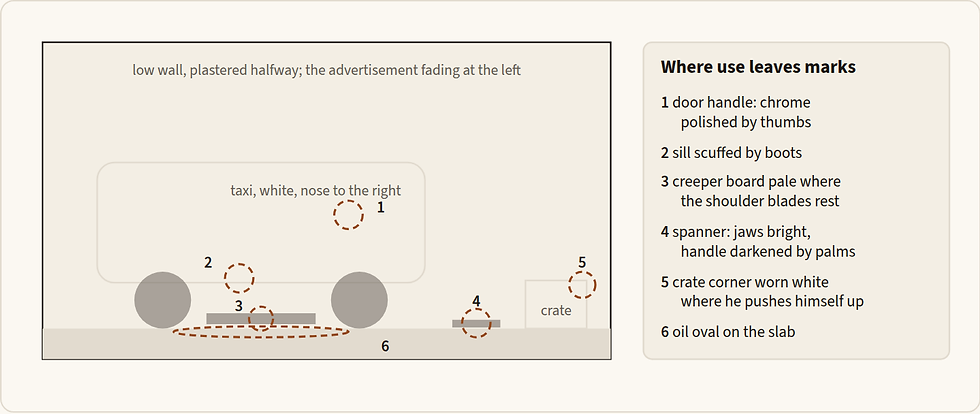
Figure 7.1 — A wear map of the repair yard. Mark the contact points first, then describe each by place; wear written as "weathered" spreads evenly and reads as a filter.
Choose three or four families of material for each frame, with one hero material. A small, honest set reads as a real place; every material at once reads as a set. The yard's list: "concrete, painted brick, enamel, steel, rubber, faded plastic; nothing polished, no chrome that is not dulled, nothing new except the bottle and its glass". It is also a list of what is excluded.
Name small, specific marks of use. In a few words: "a tea ring on the crate lid, a dent in the bucket's rim, oil thumbprints on the door".
Wear that locates itself | Where it lives |
switch-plate halo, heel scuff, chair-scrape marks | where bodies and furniture meet walls |
thumb-polished handle, rubbed brass at the high points, dulled enamel | what hands grip |
sun-faded line, softened paper labels, warped cardboard | where light and damp act over time |
dust in grooves, sediment in grout, grease bloom | what is hard to clean |
matte cleaning streaks, patch-painted wall, hairline crack | what has been cleaned or mended |
water ring, edge chips, softened corners | what is used without care every day |
7.3 People: clothes and skin
Every character had a life before the film began. The Academy's guide to costume design asks that the audience believe this, and warns that contemporary films are often the least convincing, because their clothes are too expensive, too generic or wrong for the social world.
Describe wardrobe by material and construction. "Premium jacket" is a price tag. "Washed pale-blue cotton, collar crushed by the headset, both sleeves rolled twice" is a garment. Karim wears navy cotton overalls washed pale at the knees, the zip pulled to the sternum and one cuff rolled twice, a rag through the belt loop; Fathy a sage-green cotton shirt buttoned to the collar, sleeves rolled to the elbow, dark trousers shiny at the knees, a steel watch on a worn strap. Models default to clothes with only a surface, which look airbrushed and unbuilt; costume departments build believability from the fabric's hand, the seams, the closures and the state of wear.
Three kinds of word do the work: the fabric family and its hand (herringbone wool, napped corduroy, brushed cotton, waxed canvas, oilskin, silk gauze); the construction (flat-felled seams, topstitching, tack buttons, a metal zip, a double-fold hem, a softened collar roll); and the state of wear (broken-in boots, subtle distressing).
Mix textures inside a controlled palette. Costume designers get premium realism from several textiles in one colour family, not from cleaner styling. Plan the split as proportions on named surfaces (Chapter 6), never as the string "60/30/10".
Design clothes for the light and the frame they will be in. One garment answers to several departments.
Fathy's first shirt was white. Against the white taxi and the sunlit wall it would have vanished into the frame's brightest field, and his face would have lost its separation. The worn sage green holds him against the white.
His steel watch is the only reflective thing on either body, so it gives one small highlight per shot.
A cap was rejected: its peak would put his eyes in shadow in the shot where they carry the joke (Chapter 6).
Karim's cuff "rolled twice" is human, and a continuity trap across separately generated shots; write it into every prompt that shows the arm.
Render skin as skin: pores, lines, the character's own marks, and sheen where it belongs. Nothing invented, nothing beautified. OpenAI's image-prompting guide asks for "real skin texture, worn materials, and everyday detail", and for "no glamorization, no heavy retouching" (read 30 Sep 2026). Write skin as behaviour under light, and judge it at the size it will be seen. Pores everywhere age a face and read as an overlay. Keep only the marks that are in the identity reference; let the shine follow the light and the shape of the face; and do not give lips, the wet line of the eye, hair and fabric one shared gloss: "the forehead highlight keeps its texture; a slightly brighter nose bridge; soft roll-off on the cheek".
Let makeup answer to the light. Truth and the medium can conflict. A makeup department may want a visible summer sheen on Karim's forehead; in hard sun that sheen becomes a hard white block that generated video renders as plastic. Keep the sheen on the nose bridge and temples, where the light renders it kindly, and matte the forehead. The oil in his palm is dark and matte in the creases, not a shine.
7.4 Objects and the product
Props cross from category to biography. The Property Masters Guild says that small details turn "generic" into "individual", and that random is not interesting. Its breakdown of a scene from American Pie shows how support items no script mentions (a plate, pot holders, a mother's note on the right stationery) still shape the character and the reality of a scene. Surround every hero prop with support props that make its presence inevitable. The yard is dressed in three layers, each object chosen for the habits of the men who work in it.
Layer | Objects |
Hero | the bottle; the steel 14mm spanner; the creeper, a wooden board on four castors, padded with a folded sack |
Secondary | the plastic crate with a tea ring on its lid; the overturned steel bucket; an oil rag; the taxi's open door, held on a bungee |
Background | a heap of tyres; a coiled hose; a tyre supplier's calendar on the wall; a small radio on the workshop sill; the painted advertisement, fading |
Every object you add also costs something. An earthenware water jar at the workshop door would explain the cold, but it is a second cold thing beside the bottle and competes with the joke; it is allowed in the master only, out of focus, and dropped if it does not generate cleanly.
Make a product touch the world. A product that sits in its own light reads as a sticker. Placements congruent with the story and connected to its action feel natural and persuade better; incongruent ones are discounted. The practical rule is five things at once: a truthful scale against hands and furniture; a believable state of use; contact shadows and reflections that match the room; neighbouring objects that explain why it is there; and a little occlusion or handling, so it does not sit on the image like a sticker.

Figure 7.2 — The same bottle, stuck on and set in. On the right, every clue the eye uses to believe an object is there: scale, contact, overlap and shared light.
Never make a demonstration claim with generated footage. If the product's claim is about what the footage shows, the footage must be real. A 2026 phone teaser, reported by the press, used generated footage to promote the camera's low-light capability; viewers spotted plasticky vegetables, an unnatural suit, odd hands and cobblestones with no depth, and the disclosure undermined the claim itself.
Give every object that matters a state, and keep a ledger. A state is where an object is and what condition it is in at a given moment: a bottle upright or laid down, a spoon moving or resting. The yard keeps its ledger for the bottle and the oil line, shot by shot, and a shot that shows the object must match the state in its column.
Shot | The bottle | The oil in the palm |
1 The yard | upright in Fathy's lap, beaded, darkening his thigh | not seen |
2 The palm | not seen | every crease black; no clean line |
3 The look | rising through the lower third | not seen |
4 The lay-down | laid on the palm, not gripped | fingers curling over the beads |
5 The drop | in the fist, out of frame | a bead runs across it and leaves a clean track that holds |
6 The roll-out | in Karim's fist at his chest | the clean line, small and pale, in the palm below it |
The bottle changes state on screen, once, in shot 4. Never: a second bottle, an opened bottle, a label that changes size or spelling.
Decide how legible the brand is inside the scene. Three choices: the label as a product hero, with an insert; readable naturally when the action gives it; or kept away from camera until the end card. For the yard the label reads naturally in the last two shots only, with the wordmark composited in post from the packaging artwork if generation fails (Chapter 10).
7.5 Density and the edges of the frame
Build density by ownership and use, not by count. Zones with a working centre, a support layer and a human trace; clusters named by function ("the tyre heap", "the tea corner"); fewer, more legible layers rather than more stuff. Fill shelves and surfaces with what a person with this life would own, not with the clichés of the category. Vary repeated objects in age, position and orientation, and let a mess read as a routine that has been interrupted, not as random debris. Models still struggle with counting and with placing many things precisely, so name clusters rather than long exact counts, and choose among the results.
Name the planes and what touches each edge. Any shot with more than one plane names foreground, midground and background, and what touches or leaves each edge; an unnamed layer is left to the model to invent. Scale is a share of frame height, or what the frame cuts through.
Let the frame's edges carry the world beyond them. A partial crop and a soft object in the foreground say that the room continues; the yard's bucket at the lower left corner does exactly that. Stephen Shore observed that a photograph has edges and the world does not, which is why generated images feel synthetic when they resolve every zone of the frame cleanly. Michael Frye recommends running the eye round the edges before taking a picture, looking for tangents, bright leaks and half-cut objects. The rule that follows: an edge should either contain a meaningful interruption or disappear quietly; it should never look as if an asset was clipped by chance. Doorframes, rain-streaked glass, foliage, a shoulder, the back of a chair or a lampshade half across the subject are the frame's peripheral witnesses.
Written for this book · Automotive and luxury · Nano Banana Pro, 16:9, product reference attached · passage: elements 5 to 7 (frame inventory and edges, environment and material truth, must-show anchors) · not run
Example 7.1 — a garage, its wear and its edges
A private garage on the ground floor of a 1950s villa in Zamalek, still kept as a working workshop by the family: a honed travertine floor gone dull in the aisles where feet fall and pale under the tyres, teak cabinets whose brass pulls are rubbed bright at the thumb, cream plaster scuffed at hip height by door edges, and an iron-framed window with a green shutter half open on a courtyard of palms. The pearl-grey saloon in the reference image stands at a three-quarter angle in the centre of the frame, nose to the left, filling about half the frame's width; its grille and wheel design are the reference's, unchanged, and the driver's door is open a hand's width. The floor holds its reflection only where the stone is worn. In the foreground the fold of a canvas car cover cuts the lower right corner, soft and out of focus. In the midground a pair of leather driving gloves lies on the teak bench beside the rear wheel, one finger curled. In the background the courtyard's palm shade and a shelf of oil cans, their labels turned away, run out of focus, and the frame's left edge cuts the shelf's end.Why it works
The world is written first, as materials and wear placed by touch: the brass at the thumb, the floor in the aisles, the plaster at hip height.
The product is told to be the reference; the world around it is what the words build, and the floor carries its reflection only where the stone is worn.
Each plane is named with what cuts each edge: the canvas fold at the lower right, the shelf at the left.
One small object with a biography, the gloves with a finger curled, says someone drives this car.
7.6 The world
When a world drifts towards its genre's cliché, restate it as systems and materials, plus one exclusion. A repair yard drifts towards the showroom garage: gleaming floor, tools on a pegboard, branded overalls. Pull it back with what this yard runs on: the oil-black slab, the tyre heap, the fading advertisement, the single tap, and "no pegboard of tools, no gleaming floor".
Ask the world the designer's questions before you write a word. Every world carries, besides its mood, the facts that make it behave.
The world note, for every location
Who lives or works here, and what can they afford?
What is new, and what was inherited or bought second-hand?
What gets repaired, and what gets replaced?
What do the sun, the climate and the city do to its surfaces?
Which objects drift into view naturally in the course of a day?
What kind of mess do these people leave behind?
What would never be here? (One exclusion against the genre's cliché.)
For a Saudi setting, write what the place looks like and how people help each other, not a label. A vendor-published commercial for Saudi National Day, made for the Jabal Omar development, put its notes on credible gestures of assistance, regional architectural detail, real daylight and restrained performance. Saudi speech and voices are in Chapter 21.
Match realism to the medium. A lived-in drama needs wear; a pristine luxury pack shot or a graphic frame can be exactly right as it is. For a pack shot finish is the point; for the yard, perfection is the tell. Stylised work passes when the stylisation is the idea, held with discipline, as in Coinbase's Your Way Out, whose game world was built in camera with flat printed costumes and masks. Ask viewers "was it meant to look like that?": yes is craft, no is an artefact.
State an impossible world's rules before you use them, and let damage persist. Gravity first, then the stunt; a wall broken in one shot stays broken in the next.
Decide realism in the still. The video model lifts texture and light from the frame you give it, so a plastic still makes a plastic clip. Wear, skin and materials are decided in the keyframe and protected in the motion prompt, never added there.
Template: the world in a still prompt (written for this book; not run)
[The place, its era and its class, in one line]. [Three or four material families, and what the place is not made of]. [Wear at the touch points, each by place]. [Two or three specific marks of use]. [Objects grouped by one person's habits, with one support prop beside the hero object]. [What the edges of the frame show of the world beyond]. [One exclusion against the genre's cliché].7.7 Period truth
A period world is the severest test of production design, because the audience's eye is tuned to the present: one object from the wrong decade and the whole reconstruction reads as a costume party. Mastorna, the trailer of Chapter 35, reconstructs a 1966 Italian film trailer in black and white.
Keep the period true in every object. Make the check an inventory, not an impression: list every object, fitting and garment in the frame, and ask of each whether it existed, and looked like that, in the year. Wear, too, must be of its time, not the distressing of a modern set. Write architecture by region and by what it is not ("German or Central European city architecture, not Italian"), and objects by what they are ("three small boxy 1960s ambulances with round headlights and simple rotating orange beacons").
Carry the period through every department.
The camera moves on dollies and hand-operated heads, never on a stabiliser glide (Chapter 5).
The look is written as what the film stock does: its base tone, its bloom, the softness of period lenses at the edge (Chapter 6).
A street is written in its objects: a café chair left out on the wet cobbles before shuttered shopfronts.
The title cards are set in post in a period typeface; a generated frame may study a card's print texture, never its letters (Chapter 10).
The sound is made in the edit, not prompted (Chapter 25).
What belongs to one project (the period camera, the 1.85:1 frame, the black-and-white clauses, the restored-print finish) is that project's. What transfers is the method: decide the world's rules, then hold every department to them.
7.8 Which tool for which job
Each tool carries the world into a clip differently. This chapter gives the craft; the sections below give the words.
The job | Where to look |
The world, wear, wardrobe and objects in a still | 11.3 (Nano Banana Pro); 12.3 (GPT Image 2.5) |
Keeping props and materials from the start frame through a clip | 16.3 (Kling); 17.3 (Seedance 2.5); 18.3 (Wan 3.0); 19.3 (Veo 3.1, MiniMax H3) |
Crowds, places, plates and product labels | |
A mouth and the face round it after sync | 24.3 (Sync Lipsync 3) |
7.9 The check before you sign a frame
Chapter 9 checks a frame's face, hands, light and objects before you sign it. This check asks whether the world is real.
The realism check
The set has a point of view, not just a style.
The room shows use at its touch points.
Objects cluster by function and by owner.
Wardrobe names material and construction, not only colour and mood.
The frame's edges are purposefully quiet or purposefully interrupted.
The product is part of the action and of the surfaces.
At least one small imperfection survives the clean-up.
Know the six tells. The art-direction failures of generated images group into six: materials that lie (plastic skin, fake leather, glass reflecting the wrong world, surfaces with no texture at all); over-clean staging (an ordinary scene composed like a poster, an isolated hero object, dead symmetry, no mess at the edges); objects that make no sense together (each plausible, the group impossible); physics errors (shadows that disagree, no darkening where objects meet, impossible perspective, reflections that contradict the room); density that is too even or too empty (duplicated objects, impossible counts, warped clusters); and wardrobe with no construction (no seams, no closures, no hem, no wear).
Run the four-surface check on anything tactile. Artefacts show first in four places: food, hands, fabric and the ground. Look at those four at 100 % on three frames, and check the contact shadow wherever a hand touches an object. For tactile and product work this is a gate: fail it and the frame is discarded, whatever else is good.
Failure | Why | Smallest fix |
The room looks new or staged | wear was written as a mood, or not at all | name the touch points and their marks; one exclusion against the cliché |
Everything is equally detailed | too many materials; density written as a count | three or four material families; clusters by owner; fewer layers |
Clothes look airbrushed | colour and mood, no construction | fabric, seams, closures and wear state |
Skin looks plastic or aged | no skin facts, or pores everywhere | the character's own marks; shine following the light; judge at viewing size |
The product floats | it has its own light and no contact | the scene's light, a contact shadow, an overlap, a hand for scale |
One object from the wrong world | the genre's or the present's default | an inventory against the world note or the period |
The edges look accidental | an object half-clipped, a bright leak | move the object in or out; darken the leak; add a foreground witness |
Stray printing or logos on plain objects | the model's habit | clean it in post (Chapter 10) |
This stage writes into the records: in the shot record, the world note for the location, the wear map, the material families and what is excluded, and the wardrobe by material and construction; in the shot table, the state of every object that matters at each shot's entry and exit; and, before any frame is signed, the realism check above.
Open questions
The realism check, the six tells and the material-families rule come from published craft and from studies of generated images; they are working checks, not measured methods.
Whether each video tool re-renders props and materials from the start frame differently is checked per tool (the sections in 7.8); protect the key props by name until a tool's own page says otherwise.
What to remember
Production design is story logic, not decoration. A real, expensive frame is coherent, specific and controlled, not clean.
Give the world a history, and let every surface, object and garment answer to it.
Put wear where hands go, by place; three or four material families; small, specific marks of use.
Describe clothes by material, construction and wear, and design them for the light and the frame. Skin is behaviour under light, judged at viewing size.
Props cross from category to biography; a product touches the world through scale, contact, overlap and shared light; give every object that matters a state, and keep a ledger.
Edges either carry a meaningful interruption or disappear quietly. Pull a drifting world back with systems, materials and one exclusion.
Keep a period true in every object and every department. Decide realism in the still, and run the realism check before you sign.


Comments