
Chapter 35 · Mastorna

Part 8 · Two productions, start to finish
A trailer for a film that was never made: Federico Fellini's Il viaggio di G. Mastorna, built as if it had played in Italian cinemas in 1966, in black and white, with a man's cry in the dark before the title. This chapter follows the finished trailer through every stage of the book, in the order the work was done, and points to the chapter that teaches each stage. Its prompts are printed in corrected form, brought to the standard the book teaches.
In this chapter
The trailer, its twelve phases, and where each phase sits in the book
Research and canon: ranked sources, classed claims, decisions locked
Concept and script, then continuity and coverage before any shot is prompted
Look development: the star first, the places next, the trailer in order
A finished still and a finished motion prompt for the hardest shot, the four-decker train
Dialogue: the mouth designed out of the frame, and the one shot where it stays
Music built on one motif, and silence written as a cue
The finish: cards, grain, halation and the mix
What travels to other films, and what stays with this one
Before you start. This chapter is a case, not a lesson. Each stage is taught in the chapters it points to; here you see what that stage looked like on one finished piece of work. Read it after Parts 1 to 7, or first, following the pointers as you go. The book prints Mastorna's prompts in corrected form only, labelled From Mastorna, corrected. The prompts as they ran, and the audit behind each correction, are kept in the author's research archive.
Word | In this chapter |
Phase | one of twelve steps of the author's brief; the work stops at the end of each until the author says to continue |
Canon | the settled facts of the film's world, decided once and obeyed by every department |
Source-lock packet | for one scene, what the source says must be seen and what must not drift |
In-look anchor | the star approved in the film's own light (10.2) |
Post-dubbed | speech recorded afterwards and laid to the picture, as Italian cinema of 1966 did |
Cue, motif | a cue is one piece of music placed against picture; a motif is a short tune the score keeps returning to in changed forms |
35.1 The trailer, the plan and the brief
What was made. The aim was an original Italian theatrical trailer of 1966 for Fellini's unmade film, "encountered today as a pristine restored print": black and white, 1.85:1, title cards in a serif of the Bodoni kind, and the sound of its year. It opens on black with a hoarse man's voice, "Non è possibile!". A studio fanfare and cards follow, then the story in fragments: a bored traveller in an airliner cabin, the storm, a rain-swept piazza at night, a bus made from a freight carriage, a hotel lobby lit by candles, an iron station vault, a four-decker train as tall as a building, a nightclub, an award hall where the man breaks into the outcry, three seconds of black, and a last card, PROSSIMAMENTE, held in complete silence.
The plan for the cut is a table of 44 rows totalling 138.5 seconds: 32 shots, ten cards, the cry over black and one black screen. Everything below is aimed at making that table.
The brief. The author did not ask a model for a trailer. The brief cuts the work into twelve consecutive phases under twenty-two rules and says: "NEVER jump ahead. HARD STOP after each phase and wait for: CONTINUE TO NEXT PHASE." Every phase ends with the same five things: hard conclusions, open risks, a register of locked decisions that grows from phase to phase, next-step suggestions, and the stop itself. By the end of the still phase the register held 99 numbered decisions, and 104 after motion. Each is a decision that later work builds on.
The reason for so many stops is that each phase's product is the next phase's input, and a mistake found late costs more than one found early: an ending chosen wrongly in Phase 2 would have spoiled thirty-two stills and thirty-two clips. The book teaches a lighter regime for most work, four gates (lock, spend, rights and acceptance) in place of twelve stops (8.1). Mastorna's stricter regime suits a high-stakes reconstruction from contested sources. It does not separate the spend and rights decisions from the creative ones, which is why the book separates them.
The author made the whole pass three times, each with its own concept. The third, built on the cry, is the one that was generated and cut, and it is the one this chapter follows. The chapter reads the plan and the prompts. It does not reproduce the frames, the clips or the audio, and no take numbers, variant counts or costs survive from the production. Read each prompt as the standard to write to, not as proof of what it returned.

Figure 35.1 — The twelve phases of the Mastorna brief on the nine stages of the book, with what each fixed and where the book teaches it.
The rest of the chapter takes the nine rows of Figure 35.1 in order.
35.2 Research and canon
Phases 1 and 2. Taught in Chapters 7 and 8.
Audit before any prompt. The brief hands the model a pile of research and an instruction that comes before any creative work: "Do not assume supplied research is fully correct. Audit, classify, verify, downgrade weak claims, then build forward." Phase 1 has twenty mandatory outputs, among them what the research gets wrong or overstates, a ledger of every claim, a ledger of what is allowed, excluded or debated, and the contradictions to settle next. It forbids concepts, scenes and prompts: "Do NOT write concepts, scenes, or prompts yet."
Two devices carry the audit through the whole production, and both transfer to any job.
A ranked hierarchy of sources. Primary canon is the 1965/66 screenplay, Fellini's letter to his producer and near-production evidence (screen tests, photographs, sets, contemporary interviews). Primary-adjacent material is a 1969 television documentary and documented set remnants. Secondary canon is later recollection, later Fellini films, criticism and a graphic-novel adaptation, which "may inform, never override". The ranking decides in advance which source wins when two disagree.
A class on every claim. Each claim is confirmed, near-production evidence, a high-confidence period inference, debated, excluded, or a lead to verify later. The class travels into the final table, where 31 of the 44 rows are marked confirmed and the rows the author had to infer say so.
On a commercial the ranking changes and the habit does not. The brand's own documents, the product's real dimensions and the client's legal lines are primary; a competitor's advertising is secondary; a reference film is a mood. No claim reaches a prompt without a class. Chapter 7 teaches period truth and realism, and 8.3 the obligations to settle before footage.
The canon. Phase 2 settles every dispute the audit left. The brief forces the issue: "If a contradiction cannot be fully solved, Phase 2 must force one provisional working choice and continue." Colour, aspect ratio, title-card density and the finish may not be settled earlier or later: they are audited in Phase 1 and locked in Phase 2. The memos record what was locked.
What had to be decided | What was locked |
The ending | "The ending is the concert hall, not a white void." |
Colour and finish | "restored 35mm black-and-white"; "pristine restored print" |
The aspect ratio | "1.85:1 flat (provisional historical inference, locked for implementation)" |
A narrator | "montage-led, card-led, and music-led, not narrator-led" |
Language | "Italian-only inside the artifact. English belongs only to planning materials and notes." |
The authority for speech | "All spoken lines must come from verified Italian witness material." |
Title cards | "Title cards are manual post-production graphics only." |
Later sources | "Manara usage: secondary visual-reference material only." |
Read the aspect-ratio row twice. It states its own status, provisional and a historical inference, and it is still locked, because a production cannot generate against a maybe. State how sure you are, then decide. A commercial makes the same kind of decisions at its start (8.2): the delivery specification, the rights class, the look, and how speaking shots are handled.
35.3 Concept and script
Phases 3 and 4. Taught in Chapters 3 and 4.
Concept before script. The brief asks for two or three ranked concepts before any script is written. The winner of the third pass is the cry: a trailer that opens on a man's voice over black, "Non è possibile!", and returns to it, at the face, as the outcry that closes the story. It is an idea a director can say in a sentence and a shape an editor can cut: a sound and a hold at the head, a world in fragments, the same voice at the end. The order is the point. Idea first, then script, then shots. A trailer that starts from shots arrives at a montage of good frames with nothing to be about.
Script without prompts. Phase 4 fixes, scene by scene, the source basis and its class, the duration, the dramatic function, the status of any speech, its exposure to lip-sync, where a card falls and what the sound does. It ends on a prohibition: "Do NOT break into shots, write unverified dialogue, or write prompts." The discipline is to decide what each scene is for while it is still cheap to change it. A scene's dramatic function, written in one line, is what the shot phase later serves, and what the edit later judges the shot against (Chapter 29).
Three habits from this phase suit any spot. Write the sound with the scene, not after it. Decide where the cards fall before the shots are cut, because a card is a beat of the same length as a shot. And mark, scene by scene, which shots might speak, so that the mouth is designed out or in on purpose (35.8).
35.4 Continuity and coverage
Phases 5 to 7. Taught in Chapters 5 and 8, with identity in Chapter 10.
The continuity bible. Phase 5 is a phase of its own. The bible covers the character, costume and props, environment by location family, crowd, cards, finish, performance and sound, and then two lists that matter most: the identity anchors that must never drift, and the drift warnings. The brief names three sacred anchors: "cello case, hat, overcoat". The first memo fills the list its own way, under "Sacred prop anchors": "Dark hard cello case shape and wear", "Passport scale and materiality", "Medal/prize case scale and cheapness", "White-sheeted auditorium seats", "Rusty chapel gate" and "Plank-and-string aircraft interior".
The warnings read like a continuity supervisor's notes, and each names a drift the model is known to make: "Coach must never show seats", "Cemetery must remain civic and banal, not gothic", "Concert hall must remain workmanlike, not heavenly". Write the same for your own locations: for each, the way the model will drift it towards its genre, and the sentence that stops it. 8.8 teaches the continuity plan and the order of work.
Coverage and source locks. Phase 6 runs four balance checks before any shot is cut: which characters appear where, which events are represented, how the locations are distributed, and the range of emotional registers. If one shows an imbalance, the brief says to revise before shot lock. It then builds a source-lock packet for every scene: the page in the source, what the source says must be seen, the location and character facts that cannot drift, and the forbidden drifts. For the train the packet reads: "Vagone alto quanto un palazzo", a carriage as tall as a building; faces in several levels of windows; smoke from above; figures dwarfed on the platform; iron, and nothing modern. A prompt that follows the packet cannot invent a location. On a commercial the packet is the brand's own list of what must be seen: the product's label, its colour, the legal line, the logo's clear space.
Shots that serve five masters. Phase 7 gives every shot 36 fields and one requirement: each shot must work at once as a trailer beat, as a still keyframe, as the start frame of a clip, as a continuity-safe unit, and as a unit that is safe for lip-sync or avoids it. Designing for all five before any prompt let the later phases run without surprises: the still is written knowing it will be animated, the clip knowing what the still froze, and the mouth knowing whether it will show. Chapter 5 teaches shot design; 8.5 the shot table and 8.6 the shot record.
The still that starts a clip is also written knowing how far into its action it is. The brief's rule is that for any shot with movement, the still must capture the action 20 to 40 per cent into the motion, with directional intent: weight transfer, a coat swing, dust displaced, a body leaning. That rule is the origin of the frozen instant (9.4).
35.5 Look development and masters
Phase 8, Parts A and B. Taught in Chapters 6 and 10, with the order of work in 8.8.
The order of generation is fixed before a prompt is written. The brief says: "First — Mastroianni anchor set (5–7 shots at different sizes/angles/lighting). Second — Environment anchors (one per location family). Third — Full production run in trailer order." The trailer followed it: seven anchor stills of the star, six environment anchors, then the other nineteen.
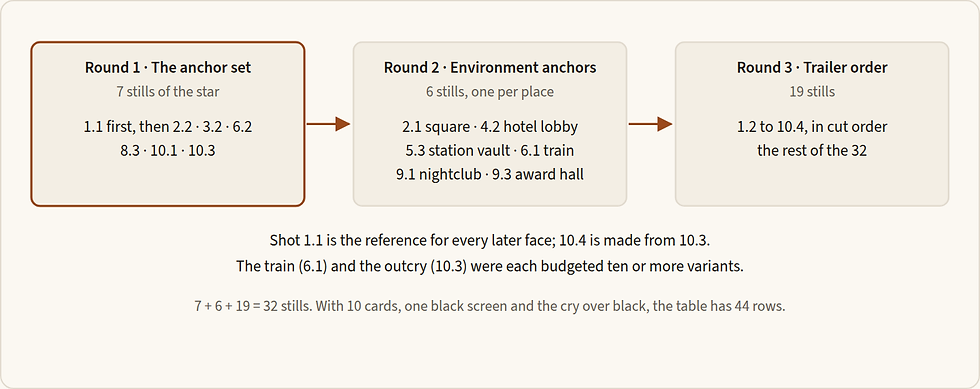
Figure 35.2 — The look-development order of the trailer: 32 stills in three rounds. Shot 1.1 was the reference for every later face; shots 6.1 and 10.3 were each budgeted ten or more tries.
Every later frame is checked against the first ones, and a face or a place that has not been settled cannot be checked. The anchor set spans close, medium and wide; cabin light, harsh top light, night rain, vault daylight and backlight; and states from clean and dry to greasepainted and erupting. If the face holds across all of that, it will hold in the trailer. The environment anchors do the same for the square, the hotel lobby, the station vault, the train, the nightclub and the award hall.
Two details are worth copying. The shot record for shot 1.1 says it is the primary anchor, referenced by every later shot of the star "for facial consistency"; and where a later frame is made from an earlier one, its record says so (shot 10.4, the held face, is made from 10.3). And the two hardest stills, the train and the outcry, were each budgeted ten or more variants before they were started. That is a production decision for one film, not a quota.
Where the book differs from the trailer. Mastorna made no master. Its first identity image, shot 1.1, was an in-look anchor: the star approved in the film's own light, doing two jobs at once, as the authority on the face and as the anchor for every later frame of it. For a film with one look that is a sound economy. On a commercial, where the light changes from scene to scene, an in-look anchor carries that grade and that room into every frame it serves. So the book's order is a neutral master first, the in-look anchors built from it afterwards, and, wherever an in-look anchor is reused, a fence around it: the face, nothing of its light (10.2). The order of work is Mastorna's; the neutral start is the book's.
The identity clause. Shot 1.1 writes the star's face from its asymmetries, which is what holds a face across a run: the left upper lid a fraction heavier than the right, a straight nose with a barely perceptible leftward deviation at the bridge, the left jaw marginally stronger; then eyes, hair, skin, the shave and the wardrobe as it stands at that point in the story. Written once from the approved first image and pasted word for word into every prompt that shows the face, that clause is the identity clause (10.4). A face retyped each time is described a little shorter each time, and drifts.
A real name. The trailer anchored the star's likeness on an actor's name ("modeled on Marcello Mastroianni circa 1965"). That was a decision for a private reconstruction of a period film. On a commercial a real person's name is a rights decision, off by default (10.8 and Chapter 34), and the asymmetry layer does the work either way.
35.6 Stills
Phase 8, Part C. Taught in Chapter 9, with the tool in Chapter 11.
All 32 stills were made on Nano Banana Pro. Each is one dense paragraph with no labels, bullets or headings, written for a model that has no memory, so each prompt carries everything its frame needs and never says "as before". The 32 prompts in the cut run from 390 to 598 words, a median of about 500. That is the band Chapter 9 gives for a complex, identity-bearing frame, and it is a target, not a floor: a prompt is finished when every element the shot needs is settled.
The order inside the paragraph is the one Chapter 9 teaches: the picture and its instant, the people and their things, the place from front to back and the details the source says must be seen; then the camera, the light and the air; then the finish; and last, at most five exclusions. World first, photography second, technical close.
The numbers are the mark of the finished grade. A lens and a stop appear in 30 of the 32 stills, a colour temperature in 31 and a contrast ratio in 28. Each is a decision a crew would make on a set, and each sits beside the result it should give: a lens beside how much of the frame the flank fills, a light beside the shadow it casts.
The shot record beside the prompt. Every still has seven fields around it, none pasted into the prompt: the intention, the aspect ratio, the reference strategy, the continuity anchors, the source-lock check, the anti-AI watch and the mid-action status. The model cannot read them; they are for the director, the next operator and the editor. The book's shot record (8.6) keeps them and adds revision levers and a declared length band. One rule comes with the record: anything the frame must show has to be in the prompt as well as in the record. The aspect ratio lives in the tool's settings, 1.85:1, and never in the words.
Shot 1.1, the anchor, is printed in corrected form in full as Example 11.5 (Chapter 11), and in five passages as Example 9.1 (Chapter 9). Here is the hardest still of the trailer.
The train. Shot 6.1, the four-decker train, was the most demanding frame in the project. Its record calls it "the SINGLE MOST IMPORTANT ENVIRONMENT SHOT", asks for ten or more variants, and asks for the one "where the train looks most physically HEAVY, most IRON, most REAL despite being impossible". An impossible object survives realism when its weight is paid for, noun by noun.
From Mastorna, corrected · Film trailer, the four-decker train · Nano Banana Pro, text only, made at 16:9 and cropped to 1.85:1 · corrected for this book; not run
Example 35.1 — an impossible train built from iron, rivets and smoke
A black-and-white photograph from a 1966 Italian film showing an enormously tall departing train inside a vast iron-and-glass station vault, seen from its side and caught mid-departure, the first carriage roughly a meter into its travel while the last still stands alongside the platform. The train is a massive iron carriage as tall as a five-story building, constructed of heavy dark iron plates riveted together with visible bolt heads in vertical rows, the surface soot-stained and oil-darkened from decades of use, each level separated by a narrow external iron ledge or running board. The train has four to five visible levels of rectangular windows with rounded corners, each window approximately one meter wide, lit from inside the carriage at approximately 3000 Kelvin warm light creating bright warm rectangles against the dark iron body, each window containing one or two human faces — all distinct in age, gender, and features — some looking out, some turned to speak to fellow passengers, some pressed against the glass; in one third-level window a face looks out with a raised hand caught mid-wave. The windows vary slightly in size and spacing — this is hand-built Victorian-era industrial engineering, not factory precision. At the base of the train, massive iron wheels sit on standard-gauge rails, the wheel diameter at least one and a half meters, heavy counterweights visible, the coupling between carriages a massive iron mechanism. Above the fourth or fifth level the train's body disappears into dense locomotive smoke that hangs in thick folds mid-fall from somewhere far above, grey-white, obscuring the uppermost portions and filling the upper vault. On the platform in the left foreground, three or four dark-coated figures stand or walk — one tilts their head back to look up at the departing colossus, another, nearest the train, caught mid-step back with one heel lifted, a third — a porter in a peaked cap — watches the train with professional indifference. Foreground left: the platform figures, whole inside the frame. Midground: the train's flank, running off the top and right edges with its levels of lit windows. Background: the vault's iron columns rising into the smoke that closes the top edge, the wheels at the bottom edge with the rails cut by it. The camera is positioned low at approximately one hundred centimeters from the platform floor, looking upward at approximately forty-five degrees, using a 28mm wide-angle lens at T/4, close enough that the train's dark iron flank fills the right and center of the frame from bottom to top and its vertical lines converge upward, the composition dominated by vertical lines — the train's body, the window columns, the rivet rows, the iron support columns of the station vault — with the platform figures and the lower plates sharp and the upper decks veiled by smoke. Primary lighting from the warm interior carriage lights illuminating the window faces against the dark iron, vault daylight from above at approximately 5500 Kelvin cool and diffused, platform practicals at approximately 3200 Kelvin warm creating pools below, the locomotive smoke scattering light in the upper reaches. Contrast ratio approximately 6:1 between the dark iron train body and the bright window-glow and steam above, so the flank stays near-black between the lit windows and the faces read clearly. The atmosphere is dense with coal smoke and steam in the upper half of the frame, clearer at platform level. The image has the tonal quality of a 1960s black-and-white release print, with fine organic silver-gelatin grain slightly finer in the bright windows and marginally coarser in the near-black iron, a faint warm ivory base tone, natural halation blooming around each lit window, slight optical softness toward the edges of the frame characteristic of period spherical lenses, and the riveted plates rendered as industrial metal, with weld seams, soot in the crevices and oil stains on the lower plates near the wheels. No color, no sleek modern train design, no smooth surfaces, no toy-like proportions, no overlaid text, subtitles, logos, or interface graphics.The object is paid for noun by noun: riveted plates in vertical rows, soot and oil, a ledge between levels, wheels at least one and a half meters across, windows a meter wide. The vertigo comes from causes in the paragraph: the five-storey scale, a wide lens close to the flank and looking up, converging verticals, smoke swallowing the top. No sentence tells the model what the viewer should feel.
The departure is frozen as positions: the first carriage a meter into its travel while the last stands at the platform, the smoke mid-fall, one figure mid-step with a heel lifted, a hand mid-wave. A clip can continue every one of them, and nothing moves inside the still.
The frame is inventoried and its edges are held: foreground, midground and background, with what runs off which edge, so the flank cannot slide into a different composition.
The finish describes capture, not a stock name: grain by tonal zone, an ivory base tone, halation at each lit window, softness towards the edges. The prompt ends on four drift locks and the closing line that bans only the overlaid layer.
Two things about this prompt are worth taking to any job. The subject is an impossible object, and the frame answers it with materials, scale cues and a lens, not adjectives. And the film's own grain and halation are not asked of the model: the prompt describes how the frame was photographed, and the print look is laid on in post, last (35.10).
35.7 Motion
Phase 9. Taught in Chapters 13 and 14, with the tool in Chapter 16.
Motion was made on Kling 3.0, from the approved still, one clip a shot. Kling 4.0 is announced (28 Sep 2026, full release due in October); until it ships, 3.0 is the version to write for (16.10). Each prompt is one dense paragraph of 137 to 177 words that begins on a camera verb and gives the rig's feel, the direction, an approximate distance, the speed, the subject's main movement and what stays protected. The book's anatomy for a moving shot has seven jobs (14.4): the camera with its rig physics, the subject's action, the life of the world, what is protected by name, the endpoint as a cuttable composition and its hold, the speed profile, and earned exclusions. Mastorna's prompts are strong on the first three. The corrected forms below add what a finished prompt still needs.
What to copy from the trailer:
A camera verb first. All 32 prompts open on one: push, drift, track, crane, pan, and one each of arc, rise, pull, tilt and retreat. All 32 are camera-move shots, so lead with the camera when the move is the point.
One approximate magnitude with a duration. "Advancing approximately fifteen centimeters over five seconds." One distance or angle and one time, in words, for a move; never a distance, an angle and a speed stacked on one move.
A body for the move. The rig is named and given weight: dolly springs, a crane arm reaching its limit. Float on generated footage is defeated by mechanism language, and the mechanism belongs in the clause that declares the camera.
The world's life in every prompt: cloth, smoke, crowd, rain, a projection flickering.
Variety, and the period's own rigs. The brief bans repeating a camera move in consecutive shots. The moves are the dollies, cranes, tripod pans and vehicle mounts of 1966; there is no Steadicam, which did not yet exist. The vocabulary of the period is a rule of the film, and a commercial has its own.
What the corrected prompts add. Three things recur across a run of clips written this way. The first is the endpoint. A camera move that ends on nothing leaves the model to search in its last second and the editor without a clean cut. An endpoint is a composition, not a plot event, written in the nouns the still already holds. For the drift towards the seated man in shot 1.1, the landing is his profile against the window's pale light, fingers at rest on the armrest. For the crane down into the piazza in shot 2.1, it is a composition too: "The descent settles with the cathedral still holding the vertical center of the frame and the beacons still turning at its base, the medics small against the wet stone." Example 16.1 prints the whole shot 2.1 prompt, and 16.3 teaches the tool's dialect for all of it.
The second is the protection sentence, which names what must not change while the camera moves: the cathedral's two spires, the faces in a window. The third is the plain hygiene line that closes a Kling prompt made with the sound switched off: "No captions, no subtitles, no on-screen text." The prompt also does not re-describe what the start frame carries. In an image-to-video call the approved frame owns its appearance, and the prompt adds only motion.
A camera hedge is not a substitute for a number. "Drift imperceptibly" is a hedge; "advancing approximately fifteen centimeters over five seconds" is a size. When a move must be gentle, state it as a small number on a named rig.
The train in motion. The motion for shot 6.1 is the most complex in the plan: a camera rising on a crane while a five-storey mass slides sideways, smoke gushing, wheels on rails, faces in every window. Its record gives the clip six seconds against a four-second slot in the table, so the cut takes its four seconds from inside the six.
From Mastorna, corrected · Film trailer, the four-decker train · Kling 3.0, from the approved still of shot 6.1, 6 s for a 4 s slot, sound off · corrected for this book; not run
Example 35.2 — a crane rises while the train slides away
Crane up on a counterweighted studio boom, the camera rising about one meter over the six seconds and lifting the view by about the height of one window: it starts from rest, reaches one steady speed within half a second, holds it for four seconds and eases to rest by the end of the fifth, with the slight strain of an arm nearing full extension. As it rises, the iron train slides slowly to the right, about two meters over the six seconds, two window-widths passing the center of the frame, while the wheels roll on the rails at the same pace. Locomotive smoke keeps falling in slow folds down the upper windows, veiling and revealing the faces; the hand raised at the third-level window completes one slow wave; on the platform the nearest figure completes his step back and the others turn their heads to follow the train. Keep every face distinct, stable and inside its own window, and keep the rivet rows, window frames and ledges rigid and straight. The rise ends with the waving face's window near the center of the frame, smoke closing the top edge and the platform figures at the lower left, and the camera holds that framing for the last second while the train still slides slowly through it. No zoom, no handheld shake, no faces repeating or melting. No captions, no subtitles, no on-screen text.Two moving systems, two measures: the camera rises about one meter over six seconds, and the train slides about two meters, each with its visible result. The speed profile (from rest, one steady speed, easing to rest) means the middle four seconds are a clean run for the four-second slot, with the ends left as handles.
The rig is declared first and given weight, a counterweighted boom nearing full extension, so the rise cannot float.
What must not change is named: every face distinct and inside its own window, the rivet rows, frames and ledges straight. The landing is built from nouns the still already holds and is held for the last second.
Nothing the still carries is described again, and the clip closes on three earned exclusions and the hygiene line.
If the clip fails. The record's retry plan for the train is worth copying. Spend the variant budget at a draft grade first. Pin the end as well as the start with a second approved frame in which the first carriage has moved a full window further on (start and end frames, 14.8). Test the still's vertigo in motion before building the sequence on it. Do not offer this clip to anyone as a model of what a video tool does easily: it is the film's hardest, and it was budgeted like it.
35.8 Dialogue and voice
Phase 10. Taught in Chapters 21 to 24.
Two rules about speech travel to any film. The first is authority: "Do NOT invent spoken dialogue. Do NOT back-translate from English into fake Italian." The Italian screenplay is treated as a real witness whose own introduction says the text results from repeated later elaboration, so each line carries a version-risk tag: low, medium, high or blocked. A line without a source is not written. For a commercial, the same discipline reads: no line reaches a voice, a plate or a sync pass until the client has approved its wording. The table records, for every spoken line, the Italian, the English, the page in the source and the risk. Nine of the 44 rows carry speech, eight tagged low and one low to medium. The book's dialogue ledger (21.11) keeps the same facts, one row for each spoken moment, and adds the voice, its rights and how the picture handles the mouth.
The second is that the design of a shot decides how much of a mouth is on screen. The brief tags every shot with possible speech for its exposure and its fallback: off-screen, profile, rear, occlusion, wide, or visible sync. In a trailer that is post-dubbed, as Italian films of 1966 were, this is a choice of framing made before the still is prompted. Figure 22.2 sets out the six strategies with the Mastorna shots that used each, and Example 22.1 prints shot 4.3, the hotel desk, where four clipped words are spoken in partial profile.
Read the trailer from the top and the exposure rises with the story. The film hides the mouth while the world is strange: a public-address voice in the cabin, voices in the dark of the bus, a hostess looking away, a whisper at a distance. It shows the mouth at the one moment the trailer is built around. The start of the outcry (10.1) faces the camera at five metres, and the outcry itself (10.3) at three metres on an 85mm lens. A fallback sits beside each: the line carried over the audience's faces, or a pull back to medium with the last sentence off-screen over the held face. Between the two most exposed moments the table places 10.2, the audience, as a planned "LIP-SYNC BREAK": crowd voices, atmospheric, synced to no visible mouth. The first memo wrote the project's ceiling as one sentence: "Visible sync is limited to a maximum of two short moments in the locked cut." A ceiling is a project decision; write yours before the shots lock.
One voice, recorded once. The cry that opens the trailer over black and the outcry at its climax are one voice. The table says to record them together and cut the head's three words from the climax take: "Generate as part of D10 recording, isolate 3 words. Same voice, same acoustic, same register." It names the voice source: an ElevenLabs voice that must match the climax voice exactly (Chapter 23). Whatever the line, a tag that recurs in a spot is one take used twice, not two takes made to match.
The contract, decided at the start. A speaking shot ships either as the exact take, with a wordless plate and a Sync Lipsync 3 pass (Chapters 22 and 24), or as a new performance, judged as a second take. Each project says which before any shot is prompted (8.2). The trailer's table does not record which contract governed the outcry, and its tolerance was a period picture dubbed in post. A modern sync-sound commercial has no such licence: the same shot is low exposure in one and high in the other. Write the tolerance into the project's decisions.
The example below treats the outcry on the exact-take route. The start frame is the outcry's keyframe made with the lips barely parted in the same light, because the line begins in the clip and the wide mouth is the sync pass's work. The plate carries the body and the timing; it carries no words.
From Mastorna, corrected · Film trailer, the outcry (shot 10.3) · Kling 3.0 standard, from the outcry keyframe with the lips barely parted, 5 s (returns at 5.04 s), sound on · the wordless plate for Sync Lipsync 3 on the exact-take route · timed to a stated take of 4.6 s: 0.4 s head, 3.8 s of speech, 0.4 s tail; the figures belong to your take · corrected for this book; not run
Example 35.3 — the plate for the climax, timed to its take
A dolly pushes in about twelve centimeters over the five seconds at one steady speed, with no zoom and no drift. In the first half second he draws one hard breath, his shoulders lifting and his eyes fixed on the lens. Then, for about four seconds, he talks straight into the lens, his jaw working through each syllable in a ragged, breaking rhythm, the head jolting a few degrees with each phrase, the neck tendons and temple veins standing with each breath, the tears running on both cheeks, his shoulders trembling. His extended left fist clenches and opens at the lower edge of the frame, well below the chin. The harsh overhead light holds steady and the backdrop behind him stays still. Keep his lips, teeth and jaw clear and true throughout the push, both corners of the mouth visible, with nothing crossing the mouth. As he finishes, the jaw drops and stays dropped, the chest heaves, his eyes stay on the lens, and the frame holds there to the end. No captions, no subtitles, no on-screen text.The plate talks without words. It follows the phrasing of a plate that passes ("talks … for about four seconds"), lets the body carry the cry's effort, and leaves the mouth's width to the pass, which draws it from the take. The model has no line to perform or translate.
The plate is timed to the take. One breath in the first half second, then about four seconds of talking under a 3.8 s take, then a landing. The whole plate is 0.44 s longer than the padded take, and the business before the talk is small.
The mouth is protected by name, and the fist that clenched beside it in the film's own clip is held at the lower edge, below the chin.
The endpoint is the held face that shot 10.4 continues, so the cut from the outcry to the silence has a frame to land on.
If the pass shows the mouth swimming, lock the camera and let the edit push in. Chapter 22 teaches designing the exposure, building the plate and lining up its timing with the take; Chapter 24 the pass itself.
35.9 Music and sound
Phase 11. Taught in Chapters 25 to 28, with Suno in Chapter 26.
The music law. The brief makes every cue "built around one recurring singable tragic motif that transforms across the trailer", and bans asking for "trailer music", "cinematic suspense", "epic orchestral", "haunting score" or a composer's style, because each names the average of a genre and not a piece. Every prompt instead specifies five layers: the form (a funeral march, a solemn waltz, a limping processional, a wounded cabaret); how the motif behaves in this cue; the harmony (key, intervals, cadence); the performance (rubato, room sound, how exposed the player is); and the refusals. Chapter 26 teaches the brief on Suno, and prints the trailer's opening cue in corrected form as Example 26.5.
In the plan the law shows as an arc of six named cues on one cello motif, after the studio fanfare (cue 0). Nascita, the birth: a warm solo. Ombra, the shadow: cello with a clarinet, the rhythm displaced. Frammento, the fragment: the motif in pieces under a funeral drum. Crollo, the collapse: one low note building to dissonant clusters. Eruzione, the eruption: a full orchestra with the motif at a tritone on the horn. Fantasma, the ghost: the last note fading under the closing cards. Each cue's function is written beside the shots it plays under (25.6 teaches spotting).

Figure 35.3 — The 138.5 seconds of the trailer: picture, music and silence on one time line. Cue names are in the text. Three stretches are true silence: the head, broken only by the cry; the six seconds after the outcry; and the last card.
Silence is written like a cue. The plan treats silence as an element with a duration. At the outcry's last word the orchestra stops at once: "All instruments cease at one instant. Room reverb decays ~1.5sec. Then: SILENCE." The held face that follows carries "SILENCE — total. No music, no crowd, no room tone", and then three seconds of black with "ABSOLUTE SILENCE". The table's note says: "This is NOT a technical gap — it is a compositional element." The last card, PROSSIMAMENTE, is held six seconds in complete silence. The head of the trailer has the same silence, broken only by the cry. Nothing in a generation workflow produces silence by default, and an unplanned gap sounds like a mistake. Give every silence its own row, its start and its length.
Sound beside the picture. The table has a sound column for every shot: the ambience, the effects that carry the world (a windscreen wiper, rain on a roof, a train's grind and steam), and where the voices sit. The rule is the one 25.7 teaches: an event is a physical thing heard from a place. Effects are made or found per event (Chapters 23 and 28), and the finish notes ask for a mix with "Centralized dialogue, restrained width, no modern surround spectacle".
The cards. All ten title cards are manual post-production graphics; none is generated. One serif family, white or warm cream on black. This is the text rule in practice: the editorial layer is composited from real assets in post, and a generated frame may study a card's texture and never its letters (10.12 and Chapter 30).
35.10 The finish
Phase 12 and after. Taught in Chapters 8 and 29 to 32.
The table and the memo. Phase 12 folds everything into two files. The trailer's shot table has one row per shot and 25 columns: order, scene and duration; the source basis and evidence class; the must-show items; the Italian line with its English, its witness and its risk; the card columns; the prompts; sound, music and lip-sync strategy; the continuity anchors and the watch list. Read it for what it is: an index. Its prompt columns hold pointers ("[SEE PHASE 8 — SHOT 1.1 FULL PROMPT — 350+ words]"), and the prompts live in per-shot outputs. It has no column for the state going in and out of a shot, a fallback route, revision levers, rights, cost, status or the accepted interval of the take, and eight of its columns exist only because this is a period trailer with a sourced script. Those gaps are why the book teaches three linked records where Mastorna had a table and a set of outputs: the shot table, the shot record and the run record (8.5 to 8.7). The 25 columns are a trailer's plan, not a schema for every film.
For the cut, a 14-column copy of the table is filed in the editing project. It keeps what a cut uses (order, scene, duration, description, the must-show items, the dialogue with its translation, the card text, sound and music notes, the continuity anchors and the watch list) and drops the generation columns, the source and risk columns and the notes: the editor does not need the prompts, and should not have to scroll past them. Chapter 31 teaches the handover.
The memo. The general memo holds everything that is not one shot's: the canon summary, the dialogue law, the card list, the music and sound-effect prompts, the generation order, the continuity warnings, a checklist, the finish notes, the failure traps and a final test. The traps are the drift warnings again, in the order a reviewer would check them: "Letting the cello case change size or wear", "Making the station steampunk", "Making Florence tourist-beautiful". The final test asks a single question: could a film historian plausibly believe this is a restored 1966 fragment?
The finish itself. The memo gives it in five lines. "Add fine grain and restrained halation in post rather than asking models to 'fake old film.'" is the one to remember: the still's finish block describes how the frame was photographed, and the film's own grain and halation are laid on at final resolution, last. The others: a "pristine restored black-and-white 35mm trailer print"; "Keep registration stable; only minimal gate movement if any"; no heavy scratches, mould, cigarette burns or nostalgia-damage clichés; "Preserve photochemical softness and silver-range blacks while avoiding digital HDR crispness". Black and white, a restored print and 1966 are Mastorna's own. Writing the finish down, and making it in post, is for every film. The order is the one 30.1 teaches: lock the cut, upscale only if the delivery needs it, colour, then grain and halation last (30.5). The sound is finished the same way: the cues are written as music, and the period's playback character, "slight optical-era softness and modest post-synchronization detachment in sound", is applied in the mix. Loudness is set to the delivery specification the owner names (30.6), never typed into a prompt. The trailer's own delivery specification is not on file.
The twenty points, and a reader outside the run. The brief ends with a per-shot checklist of twenty points in five groups: technical, source-lock, motion, continuity and anti-AI realism. The run recorded "All prompts pass 20-point validation checklist". A check made inside the conversation that wrote the prompts is a floor, not a review. The corrected prompts in this chapter exist because a reader outside the run compared them with the standard, and that reader found small things the run had not: a movement inside a still, a face described a little differently each time, a clip with no landing. Have someone, or something, outside the run read your prompts against the rules before you spend (the spend gate, 8.1). The checklist also has no line for spend, rights or the accepted interval, which the book adds.
35.11 What travels, and what stays with Mastorna
Some of Mastorna belongs to Mastorna: dollies and cranes, the 1.85:1 frame, the black-and-white clauses, the restored-print finish, and a tolerance for post-dubbed speech. For every film, three things follow from that: lock the vocabulary to the period (a 1966 frame has no stabiliser glide and no LED practicals), take the aspect from the project's master, and close with a finish the project defines.
Everything else travels. The table says where each habit is taught.
What Mastorna did | What to do on any job | Taught in |
Classed every claim and ranked its sources | no claim reaches a prompt without a class | Chapters 7, 8 |
Locked the canon and stated how sure it was | decide, and write down the confidence | |
Stopped after each phase | four gates: lock, spend, rights, acceptance | |
Built the face and the places before the run | a neutral master first, then in-look anchors | |
Wrote camera and light as numbers | a number beside its visible result | |
Recorded the frozen phase beside the prompt | write it in the prompt, as positions | Chapters 9, 14 |
Wrote the face from its asymmetries | write the clause once; paste it unchanged | |
Named the rig in every move | one rig, first; a size; an endpoint | Chapters 14, 16 |
Designed the mouth out of the frame | design exposure down first; keep a fallback | |
Wrote a motif, its form and refusals | refusals in their own field | |
Wrote silence as a cue | give it a row, a start and a length | |
Kept the finish for post | grain and halation last, at final resolution |
Three lessons leave Mastorna for every film. Every world drifts towards its genre: left under-described, a projection slides towards a modern screen and turbulence towards a disaster film. Restate the world as systems and materials and add the one exclusion the drift has earned. A coverage check before the shots are cut catches the imbalance a shot list cannot. And read your best work against the standard: a habit you are proud of is where a systematic gap can hide longest.
What Mastorna teaches. A finished production is a chain in which each link fixes the next: the audit fixes the canon, the canon the bible, the bible the packets, the packets the shot fields, the fields the prompts. Its standard is worth copying because it was made by that chain, and the small faults in its prompts were found by reading them against the standard. Correcting them is part of the method.
Open questions
The speaking-shot contract for the outcry. The trailer's table does not record whether the exact take shipped. Your project states its contract at the start (8.2); Example 35.3 shows the exact-take route only.
The corrected prompts have not been run. Whether a landing sentence, a measured second system or a wordless plate written this way improves what comes back is unproven; test one shot before you build a sequence on it.
The train. It is the film's hardest clip. Keep budget for variants, and expect to pin its end with a second frame.
What to remember
Audit the research before any prompt: rank the sources, class every claim, and let no unclassed claim reach a prompt.
Decide the canon once, state how sure you are, and lock it. An unlocked dispute is generated over and over.
Stop after each phase for a decision. The book's four gates are the lighter form of the same idea.
Build the anchors before the run: the face first, the places next, then the trailer in order. On a commercial, the master first, neutral, then the in-look anchors.
Write the still in the finished grade: world first, photography second, technical close; numbers beside their visible results; the frozen instant written as positions.
Write the identity clause once and paste it. A retyped face drifts.
End every motion prompt on a composition the editor can cut on. Name one rig, first, give each moving system one measure, and protect what must not change by name.
Design the mouth out of the frame before you prompt it, and keep a fallback beside every spoken line. Where the mouth stays, make a wordless plate timed to the take.
Give the music one motif that transforms, put refusals in their own field, and write the silences as cues.
Have someone outside the run read the prompts against the rules before you spend.


Comments