
Chapter 33 · Higgsfield

Part 7 · Running the production
Every frame, clip and lip-sync pass in this book is a request sent to a host and returned as a file. Higgsfield is the host: one account, one ledger, one job history, and the models of several makers behind one set of credits. Between request and file lie places where a production can lose a shot, pay twice, run the wrong model or record something that did not happen.
In this chapter
What Higgsfield is, how the connector reaches it, and what the web app has that the connector lacks
How it reads a request, how a route is admitted, and the presets and tools this book leaves out
Sending, waiting for and recovering jobs; references and handoffs
Three worked request records: a still, a clip and a lip-sync pass
Settings, the checks after a job, labels against what ran, limits, prices and terms, and the maintenance cadence
Before you start. Chapter 8 teaches the four gates (lock, spend, rights, acceptance) and the three records (shot table, shot record, run record); Chapter 34 teaches money and rights. This section is the tool they run on.
33.1 What it is
Higgsfield (checked 30 Sep 2026) hosts image, video and audio models from several makers behind one account and one credit balance. It makes none of the models this book uses: Nano Banana Pro is Google's, GPT Image 2.5 is OpenAI's, Seedance 2.5 is ByteDance's, Kling 3.0 is Kuaishou's, Wan 3.0 is Alibaba's and Sync Lipsync 3 is sync.so's. Keep three layers apart: the model that makes the pixels, the host that runs it and the interface through which you reach the host. A feature on one interface does not carry to another. Higgsfield has no version number, so read it by date: its changelog's latest entry is 27 Sep 2026, its terms 26 Jul 2026, its help pages August 2026. The model contracts here were last read on the connector on 27 and 28 Sep 2026; read each again before the first job that uses it (33.2).
Reach for it to run the stack from one account: stills, clips and lip-sync passes, a price check before every spend, jobs chained by number, a history of image and video jobs and a ledger of every charge. Reach for something else for a voice (ElevenLabs, Chapter 23: Higgsfield has no Arabic voice), music (Suno, Chapter 26), a feature the connector lacks (below), and probing, cutting and finishing (your own tools, Chapters 29 to 32).
How it is reached. This book teaches one route: an AI assistant connected to Higgsfield through its connector. It needs an active paid subscription, and audio generation is not available through ChatGPT's connection (Higgsfield help, 1 Aug 2026). The assistant reads each model's settings, asks for prices, sends jobs, waits, fetches files and keeps the records; the director writes or approves every prompt, spend and signature. The website, the developer API (launched 16 Sep 2026) and the makers' own sites are other surfaces: the principles hold, the details do not.
Words used throughout: the contract (what the platform says a model accepts today: settings, defaults, input roles), a quote (the price of an exact request, asked with no job started), a job number (the platform's id for a job it started), the job record (its record of a finished image or video job) and the ledger (the list of charges, the only proof of what you paid).
The account
On the Ultimate plan the account holds 1,200 credits a month, granted at the reset around the 11th at 02:00 UTC; the unused balance is removed then. Subscription credits are spent first and expire each billing cycle; packs and Auto-Refill credits expire after 90 days (help pages, 1 to 3 Aug 2026). A credit is worth about five US cents (Higgsfield's blog, 6 Aug 2026) and has no cash value. Everything generated through the connector deducts credits, whatever the plan: unlimited models are "intended for manual use, not for automated or programmatic generation" (help page, 1 Aug 2026), and on 27 Sep none was offered to the connector. A top-up is a spend decision, and it is the director's (34.3). Two assistants can spend from one account, so reconcile by job, never by the gap in the balance.
What the web app has and the connector lacks
A plan built on a feature that only the web app, the blog or a maker's site shows fails at the first job. Plan on the connector's contract; treat a web-only feature as its own route with its own lock, test and spend approval; never try it and see with credits.
Web only (checked 28 Sep 2026) | On the connector instead |
Seedance Extend, Transition, Reverse, region edit; video to 180 s (the maker's site) | extension and edit on the whole clip; no region mask |
Kling Elements, @ references, multi-shot storyboards (Kling's site, Higgsfield's developer API) | one clip per job |
Kling Motion Control; Lipsync Studio; brush inpainting; Effects and Apps; camera-move presets | a Motion Control wrapper that writes its own prompt (in no route); the rest none; presets are excluded (33.2) |
The "Unlimited mode" toggle; the Nano Banana Pro "1/4" selector | the unlimited flag (leave it out, 33.6) and the variant count |
33.2 How it reads what you give it
A request is a proposal, not a command. The platform reads your fields against the model's contract and answers in one of four ways (Figure 33.1). It adjusts: it may rename a role, round a duration or cap a count, and lists every change in adjustments. It answers with something that is not a job: a preset suggestion, a question about unlimited generations, a billing card; nothing has started and nothing is charged. It rejects, and a combination the model refuses fails the same way each time. Or it returns a job number, and only now has work started.

Figure 33.1 — The four answers to a request. An adjusted request may still run, but not as you wrote it; the answers that are not jobs start nothing.
Three facts follow. Only a job number means work started, so write it down before you wait. Only a ledger line means you paid. Only a probe, your own reading of the returned file, tells you what you got.
What every request carries
The model, by its exact id. Left out, the platform chooses (Kling for anything "multi-shot or audio"; for anything called an ad, Higgsfield's own ad tool, which is excluded). "Make a 5-second video of the kitchen" lets the platform choose; model: kling3_0 with every setting typed does not. The ids on the connector (checked 28 Sep 2026): nano_banana_pro (Chapter 11), gpt_image_2_5 (12), seedance_2_5 (17), kling3_0 (16), wan3_0 (18), sync_so (24), veo3_1 and minimax_h3 (19).
Every setting the contract exposes, typed. What a contract lacks (a seed, a negative prompt, a frame rate, on the contracts read 27 and 28 Sep) has no hidden setting.
The inputs, as pairs of a role and a value. Inputs are text, images, frames (a start frame, sometimes an end frame), video and audio, each a pair such as start_image, image_references or audio_references, with the role names the contract lists. Each picture or sound owns one job (Chapter 10). A value is a confirmed upload's id or a finished job's number, never a web address: import a web file first (up to 50 MB). Read adjustments after the call: Seedance rewrote the roles image, video and audio as image_references, video_references and audio_references (27 Sep).
Uploads. Up to 20 files at a time; each declares its file type (an MP3 is audio/mpeg), which the file must match; only a confirmed upload works, and an unconfirmed audio reference was heard as nothing.
Admitting a route, and reading its contract
On Higgsfield the contract is the truth about a model, not the maker's website, and what it leaves out is also a fact. Read it before the first paid job of the day on any model, when a model or tool is new to you, and when a setting is rejected or ignored. No route is approved from a logo alone: each leaves one dated admission line, which reads the catalogue's provider field and whether an engine is named. Provider "Higgsfield": excluded, because every model, tool and preset Higgsfield made stays out of this book's routes and examples (a decision about scope, not quality). No provider and no engine named: not used. A named third-party maker: admitted, as a host route not proven on your work until it runs.
Reading a contract
Admission: provider, engine named; write the dated line (the test-grade route check, 33.4).
Read the model by its exact id (models_explore, action get), write every difference from your notes, and search the family name (action search) for new siblings, each new and unproven.
Quote the exact request you will run (34.2).
Only if a behaviour must be confirmed, inside a spend approval, run the cheapest job: a Nano Banana Pro 2k still (2 credits, 27 Sep 2026) or a Kling standard 5-second clip with sound off (6.25). Then stop: "checked today" covers only what you read and priced.
Treat tags as claims (Kling 3.0 is tagged "multi-shot" and "motion-transfer" and exposes neither) and a list of input roles as a menu (Wan 3.0 lists a start frame and references; its maker documents that they do not combine, and the platform refused the pair every time). Do not let the recommender choose for client work: choosing a route is a lock, which is the director's. Never fall back silently: a different model, mode or host, or a dropped reference, is a new lock, and "cheaper" is never the reason. Relatives in the catalogue (older ids, the Prime, Lite and Max variants, nano_banana_2, gpt_image_2) need their own admission. Sync Lipsync 3 lists no provider, but its name names its maker, so it is admitted; which build it runs is not stated.
Presets, and the tools Higgsfield made
Higgsfield sometimes intercepts a request to animate a still and offers one of its presets, a ready-made recipe with its own look. A preset suggestion is an answer that is not a job: your request has not run. Running a preset changes the route, which is a lock. Record the preset's name and id in the run record, and send the same request again with declined_preset_id set to that id; the field suppresses only that preset, for that retry. If it is intercepted again, stop and ask. A preset that ran by mistake is an excluded route, and its result is not used. It has happened on image-to-video requests (12 Sep 2026), never on a still.
Excluded from every route in this book, because Higgsfield made them and no engine of a maker is named: Cinema Studio; Soul and its trained characters and locations; Marketing Studio, DTC Ads and Auto; Genjutsu; Ad Multiplier; presets, AutoSprite and Clipify; AI Motion Designer; video analysis and the virality predictor; Higgsfield's workflow recipes for multi-step videos and character sheets; and the sandbox that runs ffmpeg on Higgsfield's side. Not used, because no engine is named: outpaint_image, reframe, remove_background, video_deflicker, the generic video_upscale, voice_change, dubbing, generate_3d, create_voice and nano_banana_2_shots; happy_horse_video names its provider, but its maker is unverified.
33.3 The prompt, in this tool's dialect
For a host, the dialect is the request. Each model's own section teaches its prompt; this one teaches everything around it.
The order of a request. Admit the route and read the contract (33.2); name the model; set the inputs in the order the model wants (identity first on stills; on Seedance and Wan, the order of first appearance), each with one job; type every setting the contract exposes; write exactly the shot's prompt in the maker's dialect, with duration, aspect and resolution as settings and never prompt text, and with no record fields, job-handling instructions, secrets, client-confidential names or full personal names (33.9); quote the exact request with its media attached; submit, and write the job number down.
Tell the assistant in the same order (Example 33.4). "Go ahead with the plan" says nothing about credits.
Sending, waiting and recovering
A single request suits one shot you will watch; a batch suits two or more different shots. A failed call does not tell you whether a job started.

Figure 33.2 — The states of a job as the run record tracks them. The dashed box is the recovery rule: an uncertain outcome is investigated, never answered with a blind resend.
Sending a batch
Quote each different request on its own (a quote is not allowed inside a batch) and check the batch against the approval: shots, route, today's quotes, retry allowance, cap (34.3).
Build the batch, each request indexed by its shot code; submit it and write every job number down now.
Wait until all are finished. A wait that returns unfinished jobs is repeated, never answered by resubmitting.
Show the finished set once, then read the ledger (33.7).
After a rate-limit error, a timeout or a partial failure, read the ledger and the job history, then resend only the missing shots, in a smaller batch.
Never resend after a timeout, a rate-limit error or a partial failure until you know what happened. A wait that runs out does not stop the job.
"Completed" is a status, not a success. Check the error field and the file.
One authorised run is one run. A second paid job beyond the retry allowance needs the director's yes. An assistant never tops up, accepts a billing card, opens a checkout or spends an allowance; the connector's tools tell an assistant to call its recovery tool "immediately", and the spend gate overrides that.
Chain by job number. A finished still's number goes straight in as a start or end frame, a finished plate's into lip sync, with no download and upload round trip.
References and handoffs
A reference keeps its role in every tool: one job, and what it must not bring (Chapter 10). Record each as the local file, checksum and upload id or job number; a temporary link is never the only record. Every stage hands the next exactly what it needs, not a folder:
From → to | Hands on | The next stage needs |
Still → motion | the signed frame, by job number | the entry state, what to protect, what the frame shows, who owns the sound |
Voice → motion or lip sync | the locked take, a confirmed upload | the canonical line, voice, measured length, consent record |
Motion → lip sync | the plate, by job number | its probe; which audio replaces its own |
Edit → generation or finish | a missing-coverage entry; the locked cut | the entry state, one event, the exit hold; only the intervals used, and the stems |
Keep the shot's three records with it through every stage. Log every transform (a speed change, reframe, interpolation, upscale or effects pass) against its source. Resolve contradictions before you submit, never with stronger adjectives: a frame that already shows the handoff done while the prompt asks for it; an exact audio take sent to a route that re-performs it.
33.4 Templates
The finished grade is a request that will produce a file the film uses. The test grade proves a route cheaply and is never the model of a finished shot. The ROUTE line is the route line of 13.3 and the run record line is that of 8.7; the other lines are the connector's own.
Written for this book · template; not run · the finished-grade request
Template: a finished-grade request
ROUTE  Shot [id] · invariant: [what must survive] · operation: [as 13.3; for a still, text to image or anchored still; for the pass on a plate, lip-sync pass] · grade: finished · model and mode: [exact id, and its mode] · inputs in order: [role: file, version, upload or job id] · settings: [every exposed setting, typed] · reason: [one line] · fallback: [written now; running it is a new lock]
ADMITTED  [date]; provider [as listed]; engine named [yes: maker]; contract read [date]
RIGHTS  [source class of every input]; client's written agreement to the upload [y/n]; release covers AI and training [y/n or n/a]
QUOTE  [credits, exact, media attached]; [date]; packet [name]; cap [credits]; retry allowance [n]
PROMPT v[n]  (the exact text, kept whole)
→ job number [written down before the wait] → ledger → download → probe → contact sheet → RUN RECORD → the director's eye and ear
Written for this book · template; not run · the run record line
Template: the run record line
[shot]_a[attempt] · asked [id · settings] · recorded [id · settings, as the record shows them] · billed "[ledger label]" · host and interface ·
inputs: [role → what it must not give → local file · checksum · upload or job id] · parent: [start frame or earlier candidate] ·
prompt v[n] (exact text kept) · job [id] · submitted [time] · quote [x] · charged [from the ledger] · elapsed [request to file] ·
file [name · checksum] · probe [w×h · fps · frames · seconds · audio] · accepted interval [in, out) at [fps] ·
defect class [none, or a class from the shot record's watch list] · disposition [selected | rejected | held] · why [one line] ·
verdict [accepted / rejected: what failed / pending] · tech read [anyone else's technical observation; never a verdict] ·
origin [generated | upscaled | painted over | composited | practical | client-supplied | stock]
Written for this book · template; not run · the test grade: prove a route, spend the least
Template: a test-grade route check
Admission [date]; [id or tool]; provider [as listed]; engine named [yes: maker / no] → [excluded | not used | admitted, unproven]
models_explore get [exact id] and search [family name]   (zero spend)
Quote: [the exact cheapest request, media attached]; get_cost: true → [credits, date]
Only if a behaviour must be confirmed, inside an approval: one job at the cheapest shape → job number → ledger → probe → run record
Result labelled by scope: [task; route; date; "one job, one asset"]; it never becomes a default
33.5 Examples at the standard
Each example is a request record: the route before the job, the prompt (where the route takes one) and the run record entry. Run-dependent fields stand in brackets; prices are dated readings, replaced by the quote of the day.
Written for this book · beauty and personal care · Nano Banana Pro through the connector: nano_banana_pro , 2k, 16:9, one reference (the client's packshot) · not run
Example 33.1 — a hero still for a face serum, as a request record
ROUTE  Shot S12 · invariant: the bottle exactly as the client made it · operation: anchored still · grade: finished · model and mode: nano_banana_pro · inputs in order: image_references[1]: the client's approved packshot, [confirmed upload id] · settings: 2k, 16:9, count 1 · reason: the real bottle is the authority · fallback: none written, another model is a new lock
ADMITTED  30 Sep 2026; provider Google; contract read [date]      RIGHTS  the client agreed in writing to the packshot's upload [date]
QUOTE  [credits, exact, packshot attached]; planning figure 2 (27 Sep 2026); packet [name]; cap [credits]; one attempt, then edits, not re-rolls
Image 1 is the client's approved packshot of the serum bottle: take from it the bottle's exact shape, proportions, amber tint, cap and collar, and the label's size and position; take nothing of its white background or flat studio light. The bottle is locked as a 30 ml amber-glass dropper bottle about nine centimeters tall with a matte white rubber teat, a brushed-silver collar and a cream paper label wrapped two thirds around the body, carrying a small dark serif brand line above two lines of finer type that read as texture at this distance. Place this bottle, unchanged, in the scene below.
A photographic hero frame for a premium skincare commercial, captured on a large-format digital cinema camera, showing that one bottle standing closed and perfectly still, nothing in the frame moving, on the honed white-marble shelf of a Zamalek apartment bathroom at seven in the morning, slightly left of center and about forty-five percent of the frame height, its label turned to the lens. In the foreground the marble shelf runs across the bottom edge as a soft cream band, and a folded sage-green cotton towel enters from the lower right corner and is cut by the frame edge; in the midground the bottle stands with a small brass dish at its right holding a folded cotton pad; in the background a pale sand plaster wall and a slatted wooden shutter, dissolved into soft vertical shapes, touch the top right edge. The marble shows fine grey veining, the brass is worn soft at the rim, and the plaster shows a hairline crack. The label faces the lens with its type small and soft, so the client's artwork can be set in post. The camera sits eight centimeters above the shelf and seventy centimeters from the bottle, level, on an 85mm lens at T/2.8, so the label is sharp while the wall falls away into soft shapes. Morning daylight enters from camera left through a carved mashrabiya screen at about 5600 K, breaking into a lattice of soft-edged light across the marble and laying a narrow highlight down the left of the glass; the marble returns a gentle fill from below, and a small 2700 K sconce at far right puts a warm glint on the brass; the contrast ratio is about 3:1, so the shadow under the bottle stays soft and readable. Faint dust hangs in the light near the window. The color sits about six parts on cream marble and pale sand plaster, three parts on amber glass and brass, and one part on the sage-green towel. The finish is that of a large-format digital cinema capture: a neutral base tone, deep amber shadows that keep detail, clean warm highlights that roll off without clipping, fine restrained grain and gentle halation on the brass glint; delivery grain is added in post. No people, no hands, no second bottle, no stylized reflections in the glass, no overlaid text, subtitles, logos, or interface graphics.RUN RECORD S12_a1 · asked nano_banana_pro, 2k, 16:9, count 1 · recorded [id · settings in the job history] · billed "[ledger label]" · Higgsfield, connector · inputs: image_references[1] → bottle shape and label position only, no room, no light → [file · checksum · upload id] · parent: none · prompt v1 (exact text kept) · job [id] · submitted [time] · quote [x] · charged [from the ledger] · elapsed [ ] · file [name · checksum] · probe [2752 × 1536 when last probed at 2k 16:9] · accepted interval: none, a still · defect class, disposition, why, tech read [after the verdict] · verdict: pending, the director's eye at 100 % and 200 % · origin generatedCopy the roles and the split: the packshot has one job and is fenced from what it must not bring; route, rights, quote and record sit around a prompt with no aspect, resolution, credit or client detail.
Copy the camera and light as numbers beside results: 85mm at T/2.8 for the falling-away wall, 5600 K through the screen for the lattice, 3:1 for a soft readable shadow.
Copy the label handling: the type stays soft and the artwork is set in post.
Written for this book · food and drink · Kling 3.0 standard through the connector: kling3_0 , 5 s, 16:9, sound off, start frame by job number · not run
Example 33.2 — an iced-hibiscus clip, as a request record
ROUTE  Shot S12m · invariant: the signed frame of the iced hibiscus glass on a Downtown Cairo café table · operation: start frame · grade: finished · model and mode: kling3_0, std, start frame · inputs in order: start_image: job [id] of S12 (the signed 2k frame, by its number) · settings: 5 s, 16:9, sound off · reason: a silent, measured slider move; a start frame is a strong reference, not a pixel lock, so frame 0 is checked at 100 % · fallback: seedance_2_5 with the same start frame, after a new lock
ADMITTED  [date]; provider Kuaishou; contract read [date]: sound defaults on, so it is typed off
QUOTE  [credits, start frame attached]; planning figure 6.25 with sound off, 8.75 with sound on (27 Sep 2026); packet [name]; one authorised run
The camera is on a slider, pushing straight toward the glass, advancing about twelve centimeters over the five seconds in one slow settling move, a soft start, a steady middle and a damped stop, so the glass grows from about half the frame height to about two thirds. Down the near side of the tall glass of iced hibiscus, one bead of condensation slides about four centimeters in the first three seconds, gathers a smaller bead on the way and comes to rest at the base with a tiny wet bloom. Inside the glass, one ice cube drifts about a centimeter and settles against the rim at about the second second, and the mint trembles once through a few millimeters. The café lives around it: the ceiling fan's shadow drifts about ten centimeters across the marble table, the curtain at the window stirs a few centimeters at its hem, and a thread of steam rises about fifteen centimeters from the copper coffee pot at the edge of the background. Protect the glass's shape, the drink's color, the mint sprig, the table and the light exactly as the frame has them. The push ends composed: the glass fills the lower two thirds of the frame, the bead at its base, the mint catching the light at the upper right, and the frame holds for the last second. No new ice, no pouring, no hands entering the frame, no overlaid text, subtitles, logos, or interface graphics.RUN RECORD S12m_a1 · asked kling3_0 std, 5 s, 16:9, sound off · recorded [id · settings in the job history, the sound state included] · billed "[ledger label]" · Higgsfield, connector · inputs: start_image → the signed frame only → job [id], no upload · parent: S12 · prompt v1 (exact text kept) · job [id] · submitted [time] · quote [x] · charged [from the ledger] · elapsed [ ] · file [name · checksum] · probe [1284 × 716 · 24 fps · 121 frames · 5.04 s · no audio stream, as std 5 s clips with sound off returned, 12 to 27 Sep] · accepted interval [in, out) at 24 · defect class [ ] · disposition [ ] · why [ ] · verdict: pending · tech read [ ] · origin generatedCopy the measured moves: one magnitude for each moving system, with its duration and visible result (twelve centimeters over five seconds, the glass growing to two thirds).
Copy the movers and the endpoint: each mover is already in the signed frame, so the prompt says what it does and never re-describes it; the push ends on a composition you could cut on, then the hold.
Copy the setting: silence is sound: off, typed, because a word in the prompt does not silence Kling.
Written for this book · telecom and tech · Sync Lipsync 3 through the connector: sync_so , cut_off , a Kling plate by job number and a locked Egyptian take · not run
Example 33.3 — a lip-sync pass on a locked take, as a request record
CONTRACT  decided at the start [date]: the exact take must ship; a voice actor's locked recording; Sync Lipsync 3 fits the mouth
LINE  L3 «أول مرة المكالمة تكمل من غير ما تقطع.» Egyptian Arabic; speaker [name]; take v02 locked [date]; release covers AI use and platform training [reference]
TAKE  4.6 s: head 1.2 s, speech 3.0 s, tail 0.4 s; WAV 48 kHz mono, about −20 LUFS, peaks at −3 dBTP; uploaded as MP3 [confirmed upload id]
PLATE  Kling std, 5 s, sound on (typed); leans and taps for 1.2 s, then talks quietly, no words, from 1.2 s to 4.2 s, measured on the approved plate; job [id]; returns 5.04 s, 0.44 s longer than the take
ROUTE  Shot S21s · invariant: the approved take, word for word · operation: lip-sync pass on the plate · grade: finished · model and mode: sync_so · inputs in order: input_video: job [plate id]; input_audio: [confirmed upload id] · settings: sync_mode cut_off · reason: the take is the authority, and the pass has no prompt · fallback: re-plate once, then redesign the shot's exposure; a re-performance is a change of contract
ADMITTED  [date]; no provider listed, the name names sync.so; build not stated
QUOTE  none: the platform rejects a quote for lip sync; planning figure 18.15 (charged six times on 12 Sep 2026, plate 5.04 s, take about 4.6 s); packet [name]; cap [credits]
RUN RECORD S21s_a1 · asked sync_so, sync_mode cut_off · recorded: not in the job history, so this line is the only record · billed "[ledger label]" · Higgsfield, connector · inputs: input_video → the plate only → job [plate id], probe attached; input_audio → the take only → [file · checksum · upload id] · parent: plate S21p_a2 · no prompt · job [id] · submitted [time] · quote: none, the platform rejects one · charged [from the ledger] · elapsed [ ] · file [name · checksum] · probe [the plate's frame size · 24 fps · about 110 frames · about 4.6 s, the take's length · AAC 48 kHz mono] · accepted interval [in, out) at 24 · defect class [ ] · disposition [ ] · why [ ] · verdict: pending, the checks of 24.7 · tech read [ ] · origin generatedCopy the contract line first: the decision is written before any spend, and the fallback is a change of contract.
Copy the three levers: the pass has no prompt, so the plate, the take and sync_mode are the whole request; head, speech and tail are summed against the plate first.
Copy the record and the Arabic: lip-sync jobs are absent from the job history, so the run record is the record; the canonical line sits in it exactly as approved, and captions are typed from it.
Research exemplar · a brief for an assistant driving the connector, not a prompt for a model · written, never run · 62 words
Example 33.4 — a generation job brief
Prepare one shot using the approved prompt, exact selected model and attached media roles. Verify the current schema and estimate. Record the request and a stable shot/take identifier. If submission becomes uncertain, recover its status before starting another job. Save the completed result and inspect it against the shot acceptance criteria. Report actual settings, estimated cost and the accepted source interval separately.Copy the order, and the last sentence that keeps settings, estimate and accepted interval apart. For a spend, add "inside approval [reference]".
33.6 Settings
Type these on every job (values last read on the connector on 27 and 28 Sep 2026).
Setting | Value to use | Why |
Model; aspect | the exact id; the aspect, typed everywhere | left out, the platform picks its own; some models state no default aspect (Nano Banana Pro, Kling) |
Resolution | typed | GPT Image 2.5 defaults to low quality at 1k; Nano Banana Pro's 1k costs the same as 2k |
Sound | Kling 3.0: typed on or off (default on). Seedance 2.5: typed (generate_audio is on by default) | silence is a setting, not a sentence; Kling Turbo has no switch and returned a stereo track on all four clips (12 Sep 2026) |
Mode | Seedance 2.5: omni_reference whenever pictures or audio go in | left alone it is text to video; the job record stores no mode |
Lip-sync mode | sync_mode: cut_off | the default, bounce, plays the video forward and then backwards |
count; get_cost | count 1 unless you mean several jobs; get_cost: true to quote | each variant, 1 to 4, is a separate job and charge; a quote starts no job |
use_unlim; declined_preset_id | leave the first out; the second only on the retry after a preset suggestion | an allowance makes the platform answer with a question and no job; the second declines an offer you received |
Batch tools take 1 to 12 requests with count fixed at 1 and no quote inside. Waiting takes 1 to 12 job numbers and at most 15 seconds a call. Uploads take 1 to 20 files. show_generation_by_ids takes up to 60 jobs.
33.7 Checks before you sign
The platform's word for "done" says nothing about the charge or the file.
After every job
Read the ledger first. Its line is the only proof of the charge. Where the price you saw and the debit differ, write both.
Download the original, wait until the file has finished writing, and archive it. A checksum taken from a half-written file is wrong.
Probe it: frame size, frame rate, duration, frame count, sound. A successful request proves nothing about the file.
Make a contact sheet (six stills at 0, 20, 40, 60, 80 and 100 per cent of the clip), then look at the key frames at 100 % and 200 %, then listen. The sheet finds problems; only the director's eye and ear pass the shot.
Write the run record (the run record line, 33.4); then judge, or label the result a technical read.
Cut on the probed file, never on the requested length. No handle length is universal. What came back on the connector between 12 and 27 Sep 2026 is an observation, not a guarantee:
Request | The file |
Nano Banana Pro, 2k 16:9; GPT Image 2.5, 2k 16:9 | 2752 × 1536 PNG; 2688 × 1520 |
Seedance 2.5, 480p and 720p, 5 s | 854 × 480 and 1280 × 720, 24 fps, 121 frames, 5.04 s; sound on: AAC 32 kHz stereo; off: no audio stream |
Kling 3.0 standard, 5 s and 10 s | 1284 × 716 (the record says 1280 × 720), 24 fps, 121 and 241 frames; sound on: AAC stereo |
Kling 3.0 pro, 5 s; Kling Turbo 9:16; Wan 3.0, 720p | 1912 × 1080 (the record says 1920 × 1080); 1076 × 1928, with a stereo track on all four clips; 1280 × 720 at 30 fps |
Sync Lipsync 3, cut_off | the plate's size; the take's length (112 frames, 4.667 s, from 121-frame plates), as AAC 48 kHz mono |
The containers are MP4. Seedance at 1080p (its maker documents 1920 × 1080 in 10-bit HEVC, which some players cannot open) and Kling's "4k" mode have not been probed on Higgsfield. Conform a wrong frame size in the edit; never stretch it. Use your own probe, never Higgsfield's video analysis, which is excluded.
Labels against what ran
Every time you log a job, compare four things: what you asked for, what the job record says, what the ledger billed and what the probe found. They can be four different things (Figure 33.3).
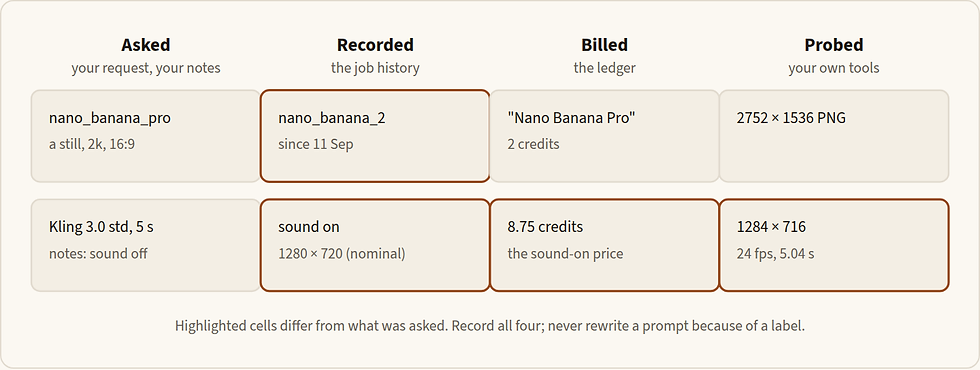
Figure 33.3 — Four accounts of two jobs (observed 12 and 27 Sep 2026). The still ran as asked but is recorded under another name; the clip's own record showed that its sound had run on, and the bill agreed.
Record stills as "Nano Banana Pro route on Higgsfield (recorded as nano_banana_2)". Every still sent as nano_banana_pro from 11 to 27 Sep 2026 is recorded as nano_banana_2 and billed "Nano Banana Pro"; all twelve stills of 27 Sep agree. You know what you asked for and what you were billed, not what ran underneath, so notes say "Nano Banana Pro route", never "Gemini 3 Pro Image"; check that the ledger says "Nano Banana Pro".
Seedance 2.5 records carry no mode (model: default, genre: auto, speedramp: auto): log the mode yourself. GPT Image 2.5 is stored as model: flare; Flare and Sunburst are model variants, not lighting.
Trust the job record over your notes about what was sent. A Kling plate logged "sound off" in the notes was recorded "sound on" and billed 8.75, the sound-on price, not 6.25.
Quote probed frame sizes, never the record's (it stores nominal sizes), and never rewrite a prompt because of a label: a label is a record problem, not a craft problem.
The job history, and the three records
Use the job history to recover what ran. It holds the prompt and settings of every image and video job (450 records on 27 Sep 2026); when it and the notes disagree about what was sent, the history is right. It holds no lip-sync or audio jobs, no charges, no preset declines, no Seedance mode and only the nominal frame size. Recover an expired result link from it, never by generating again, and archive the original download at once: the connector states no result-link lifetime, and Higgsfield's terms give it no duty to store your content.
The three records share the shot's id (8.5 to 8.7 build them). The platform keeps nothing of the shot table; it keeps the prompt and settings of image and video jobs for the shot record, and the ledger's charge and the job record's label for the run record. You add the rest: the route line, rights and accepted interval; the intention, anchors and watch list; the mode, the declines, lip-sync and audio jobs, returned size, hash and verdict.
A prompt must not contradict its shot record: read them against each other before you submit. Label every result by its scope, with its date: a condition is called proven only when that exact condition passed. Label every asset by its origin (the last field of the run record line) with its route, prompt version, rights class, transformations in order, output hash and approver; editing does not launder an origin.
33.8 Failures and fixes
What happened | What it means | Do this |
Timeout, no job number; a wait that ran out | the outcome is unknown; the job may still be running | ledger and history first; look it up by number; never resubmit |
Rate-limit error, or part of a batch failed | some requests may have run | ledger and history; keep the numbers you got; resend only the missing items, in a smaller batch |
"Completed", no usable file | an error behind the status | read the job record; report it; no silent resend |
A preset suggestion, an "unlimited" question or a billing card | not a job | record it; for a preset, resend with the decline field; for the others, stop and ask |
A setting rejected or ignored; a role renamed in adjustments | the contract changed, or the platform mapped your role | re-read the contract; record the role actually used; never retype a setting from memory |
The model "hears nothing" | the upload's type did not match, or it was never confirmed | upload the matching type; confirm; use the new id |
The route refuses the approved frame | the wrong route for the shot | stop and ask (a lock); never switch models yourself |
A "silent" clip has sound | sound was left on, or the model is Kling Turbo | type sound off on Kling 3.0, or strip the track in the edit |
A wrong checksum; a frame size a few pixels off | the file was read mid-write; the platform's transcode | probe after the download finishes; conform in the edit |
The retry ladder, smallest lever first. For a platform fault: (1) read the ledger and the job history; (2) wait again on the same job number; (3) retry a failed quote once; (4) resend only what is missing, in a smaller batch; (5) if the same request is refused twice, change the request (Wan: pass the keyframe as an image reference); (6) if the route cannot take the approved frame or reference, stop and ask, because a new route is a new lock. Credits for a failed generation usually come back within minutes and appear in the ledger; Higgsfield says specific models might not refund (help pages, 1 and 3 Aug 2026), so read the ledger after any failure. For a failed picture, the ladders of 9.9 and 14.16 apply.
33.9 Limits, prices and rights
Limits (checked 27 and 28 Sep 2026). Requests, batches, waiting and uploads: 33.6. Reference counts are not stated on any video model, so plan inside the maker's limits. Jobs at once: rate-limit errors above about three on one model (12 Sep); four in one batch accepted (27 Sep); the connector's own limit is not yet known. A quote works on single image, video and audio requests and the image upscale, not on batches, lip sync, video upscale or the Motion Control wrapper.
Prices. Every price is a dated planning figure; the quote of the day decides, and only the ledger is the charge (34.1). Each model's prices are in its own section. Platform readings: the image upscale (ByteDance), 2752 × 1536 to 4k, 2 credits (quoted 27 Sep); Sync Lipsync 3, 18.15 credits for a plate of about 5 s (5.04 s) and a take of about 4.6 s (4.649 s), charged 12 Sep, no quote possible. Seedance 720p 5 s rose from 32.5 to 35 credits between 17 and 20 Sep, and 480p from 12.5 to 15 by 27 Sep.
Audio on Higgsfield. The approved voice is made elsewhere and reaches Higgsfield as a confirmed upload. Its 113 preset voices (11 Sep) include no Arabic. Its speech tools are for English scratch lines only: the ElevenLabs engine (version not stated) with preset voices, and ByteDance Seed Audio 1.0, whose one-shot clone of an Egyptian voice was rejected by ear on 12 Sep. Do not clone a voice on Higgsfield (rights, 34.8). Its music, effects and game-voice models are marked "Game pipeline only".
Rights and terms (Higgsfield's terms of use, updated 26 Jul 2026, binding existing accounts from 27 Aug; re-read 30 Sep 2026, unchanged; help pages August 2026). This is a plain reading by non-lawyers, not legal advice; save a dated copy of the terms with every project.
Ownership and use. Higgsfield claims no ownership of your inputs or outputs and does not restrict commercial use, advertising and broadcast included; paid plans download without a watermark. Your rights in outputs you generated and exported survive cancelling, and you "may transfer or sublicense your rights in Outputs to your clients". Outputs are not guaranteed unique, so never promise a client exclusivity.
What it keeps. A licence over everything you upload and generate, including "to train, develop, enhance, evolve, and improve" its AI models. No setting stops training on the plans read (Ultimate, Team, Scale); deleting content stops future training only. It has no duty to store your content and may retire any model or feature at any time. Archive masters, prompts, settings and references locally.
Visibility. Generations are private by default, but where you choose no level of access the service "may default to its most permissive setting". Turn off Auto-publish new generations (Manage Account, Personal Profile) before the first upload.
What every upload promises, and what you carry. That you hold every right, release and consent it needs, including for a face or a voice; Higgsfield performs no clearance. Keep full names out of prompts; use code names. Do not remove provenance marks; where the law requires it, disclose that an output is generated. Activity through an automated agent counts as yours. Outputs are provided as is; you indemnify Higgsfield for content you supplied without rights; its liability to you is capped at the greater of six months of fees or $100; disputes go to arbitration under California law.
Enterprise. Its Enterprise page (30 Sep 2026) promises no training on customer data under a contractual guarantee, SOC 2-aligned controls and contract-backed indemnification of outputs, and names no data processing agreement.
What may ship to a client. Outputs, on your rights, with the client told what is generated and the provenance marks left in place; nothing uploaded without a release; nothing from a model whose maker's own policy forbids the use (34.7 reads those policies).
33.10 Version notes
What changed (dated to the platform's own log and the connector's records). 11 Sep 2026: stills sent as nano_banana_pro began to be recorded as nano_banana_2. 16 Sep: the developer API launched. 22 Sep: GPT Image 2.5 and Seedance Draft Mode announced. 27 to 28 Sep: new finishing tools and third-party video models appeared.
Announced. Kling 4.0 (announced 28 Sep 2026; full release due in October) is not in Higgsfield's changelog as of 27 Sep; a kling4 id, when it appears, is a new admission (16.10).
The cadence, so that nothing changes silently. Apart from a retest, every line is a set of zero-spend reads.
When | What |
Before any paid batch | the five-minute preflight: the route (exact model, provider, mode, plan); the inputs (roles, formats, rights); the settings as the platform spells them; today's quote and the cap; where the file is saved, the fallback, the stop conditions |
Monthly, after the credit reset around the 11th | a scan of the models, terms, prices, labels and voices (below) |
Quarterly | a full audit of routes, rights, contracts, prompts, examples and costs |
Immediately, and before changing a default | a recheck after any change of model, provider, endpoint, interface, plan, price, terms or file behaviour; a retest, never a silent update |
The monthly scan. Read each model in your stack by its exact id against your notes; admit or refuse every new or changed model and tool; quote each model's reference requests; list the voices; read the balance, ledger, changelog, makers' pages and the date on the terms; ask what runs under nano_banana_2. Write a dated note with proposed edits; the director approves them.
Stop the affected work when a route's identity cannot be confirmed, a rights or privacy issue appears, the contract changes something your plan assumed, the cap is reached, three catastrophic failures come in a row, or you cannot separate two causes.
Open questions
What runs under nano_banana_2, and which ElevenLabs version runs under Higgsfield's speech engine. Until Higgsfield answers, record "Nano Banana Pro route (recorded as nano_banana_2)".
What Seedance 1080p and Kling's "4k" return: one probe of each.
Whether the model sees resized uploads (the job history stored uploaded references as resized JPEGs, 27 Sep): run one fine-lettering reference as an upload and as a job number, and compare.
Whether the developer API counts as "on the platform" for a production that needs Kling multi-shot: the director decides.


Comments